

About the 1936 Exhibition Collection
The British School at Athens celebrated its 50th anniversary in 1936 with a large public exhibition at Burlington House at the Royal Academy of Arts in London. The exhibition, British Archaeological Discoveries in Greece and Crete 1886-1936, consisted of a special display of Minoan culture related to the discoveries at Knossos by Sir Arthur Evans as well as the excavations of the School including: Phylakopi, Kamares Cave, Palaikastro, Mycenae, Sparta, Perachora, Thessaly, Macedonia, Lesbos, Cyprus, Ithaca, and Megalopolis (Arcadia). It also included displays of Travels and Studies in Greece and Asia Minor, the Genose in the Levant, Monasteries in Athos, Byzantine Music, Byzantine Architecture and Decorative Arts, Greek Island Embroideries, Special Studies of Greek Pottery and Sculpture, Restoration of Ancient Monuments, Studies of Modern Greek Life and the School buildings and officers.
Since original ancient artifacts could not be transported to the exhibition in London, the displays consisted of replicas of ancient artifacts, modern ethnographic artifacts and illustrative panels with original watercolour drawings, many of which were done by Émile Gilliéron and Piet de Jong, and photographs.
The 1936 Exhibition Collection contains the surviving panels with original artwork from this exhibition.
A repeating pattern in black, white, and red. Framed. The original description in the catalogue reads: "Decorative designs based on Middle Cycladic pot-paintings like (2-6), much enlarged."
A repeating pattern in black, white, and red. Framed. The original description in the catalogue reads: "Decorative designs based on Middle Cycladic pot-paintings like (2-6), much enlarged."
Semicircle showing a repeating pattern in shades of grey. Framed. The original description in the catalogue reads: "Decorative designs based on Middle Cycladic pot-paintings like (2-6), much enlarged."
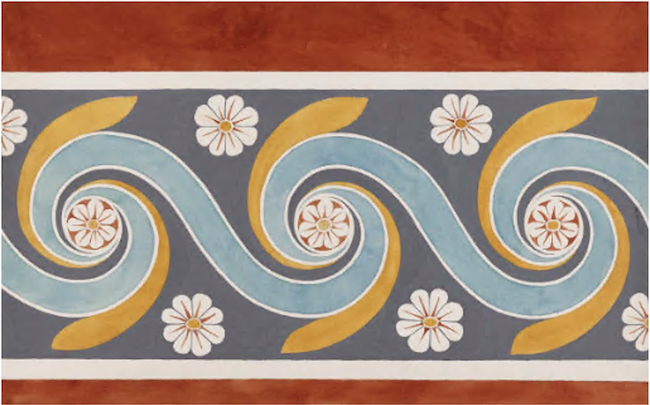
A repeating pattern with swirls and flowers, in red, white, yellow, and shades of blue. Framed. The original description in the catalogue reads: "17-18 Wall paintings from houses of Middle Cycladic date: These are not strictly fresco, but were painted on thin limewash, sometimes obliterating earlier decorations. A jar from settlement contained the crimson pigment, a mixed silicate and oxide of iron; other colours are blue, yellow, white, and a faded red, with black for outlines. The designs are in Cretan style: but compare the naturalistic decoration of the pottery (2-6, 8a above). 17 Design of Spiral and Rosettes, reconstructed by T. D. Atkinson: compare spiral fresco designs from Knossos in the Minoan Room"
Illustration of fragments of wall painting showing flying fish, in blue and yellow. Framed. The original description in the catalogue reads: "17-18 Wall paintings from houses of Middle Cycladic date: These are not strictly fresco, but were painted on thin limewash, sometimes obliterating earlier decorations. A jar from settlement contained the crimson pigment, a mixed silicate and oxide of iron; other colours are blue, yellow, white, and a faded red, with black for outlines. The designs are in Cretan style: but compare the naturalistic decoration of the pottery (2-6, 8a above). 18 Fresco-Painting of Flying Fish among rocks, seaweed and shells: a portion only of a large composition represented by many fragments: a masterpiece of Minoan naturalism."

The items in this section of the exhibition were numbered 71-75
Card base with six watercolour illustrations of pottery. The number 71 is pasted in the bottom left corner. Beside each image is a later annotation in biro giving bibliographic references. The original description in the catalogue reads: "Middle Minoan pottery, simple ornament, black on buff."
An illustration of a pot with one handle, painted black with a design in white and red. Some parts are a paler colour, which may indicate these were not parts of the original fragments found but added to complete the vase before painting or imagined by the artist. The original description in the catalogue reads: "Middle Minoan pottery, simple ornament, black on buff."
An illustration of a pot, painted black with a design in white and red. Some parts are a paler colour, which may indicate these were not parts of the original fragments found but added to complete the vase before painting or imagined by the artist. The original description in the catalogue reads: "Middle Minoan pottery, simple ornament, black on buff."
An illustration of a pot with a spout, painted black with a design in white and red. Some parts are a paler colour, which may indicate these were not parts of the original fragments found but added to complete the vase before painting or imagined by the artist. The original description in the catalogue reads: "Middle Minoan pottery, simple ornament, black on buff."
An illustration of a pot with tow handles, painted black with a floral design in white and red. Some parts are a paler colour, which may indicate these were not parts of the original fragments found but added to complete the vase before painting or imagined by the artist. The original description in the catalogue reads: "Middle Minoan pottery, simple ornament, black on buff."
An illustration of a pot with two handles and a spout, painted black with a design in white and red. Some parts are a paler colour, which may indicate these were not parts of the original fragments found but added to complete the vase before painting or imagined by the artist. The original description in the catalogue reads: "Middle Minoan pottery, simple ornament, black on buff."
An illustration of a pot, painted black with a design in white and red. Some parts are a paler colour, which may indicate these were not parts of the original fragments found but added to complete the vase before painting or imagined by the artist. The original description in the catalogue reads: "Middle Minoan pottery, simple ornament, black on buff."
Card base with seven watercolour illustrations of pottery. The number 72 is pasted in the bottom left corner of the bottom left hand image (1936/01/02/02/05), with a faint handwritten "72" in a circle to the left of the image. Letters a-g are written lightly in pencil near the top left corner of each image. Beside each image is a later annotation in biro giving bibliographic references. The original description in the catalogue reads: "Middle Minoan polychrome ware."
An illustration of a grey pot with a spout and handle, and a white design on the body. The original description in the catalogue reads: "Middle Minoan polychrome ware."
An illustration of an orange-brown pot with a handle, with a white design painted on. Some parts are a paler colour, which may indicate these were not parts of the original fragments found but added to complete the vase before painting or imagined by the artist. The original description in the catalogue reads: "Middle Minoan polychrome ware."
An illustration of the remains of a vase painted with red, orange, black, and white. Much of the pot is left blank: presumably the painted sections are those that survived, and the rest was recreated from the fragments. The original description in the catalogue reads: "Middle Minoan polychrome ware."
An illustration of an pot, painted grey with red and white decoration. One handle and a spout are visible. Some parts are a paler colour, which may indicate these were not parts of the original fragments found but added to complete the vase before painting or imagined by the artist. The original description in the catalogue reads: "Middle Minoan polychrome ware."
An illustration of pot with two handles and a spout, painted grey with red and white decoration. The original description in the catalogue reads: "Middle Minoan polychrome ware."
An illustration of pot with two handles and a spout, painted orange with red and white decoration. Some parts are a paler colour, which may indicate these were not parts of the original fragments found but added to complete the vase before painting or imagined by the artist. The original description in the catalogue reads: "Middle Minoan polychrome ware."
An illustration of pot with two handles and a spout, painted grey with a decoration of a white octopus with red and orange details. Some parts are a paler colour, which may indicate these were not parts of the original fragments found but added to complete the vase before painting or imagined by the artist. The original description in the catalogue reads: "Middle Minoan polychrome ware."
Card base with a black and white photograph of a landscape. The number 73 is pasted in the bottom left corner, and smaller in the centre of the top edge. There is a reinforced hole in each corner. Below the image is an annotation in biro giving a bibliographic reference. The original description in the catalogue reads: "View from the cave, over the Messara Plain."
A photograph of a landscape. In the foreground are trees, beyond which a plain also with trees can be seen, leading up to mountains partly obscured by cloud. The top half of the image is the sky. In the bottom left corner is written "Boi//annay - Genève". The original description in the catalogue reads: "View from the cave, over the Messara Plain."
Card base with a black and white photograph. The number 74 is pasted in the bottom left corner, and smaller towards the left of the top edge. Below the image is an annotation in biro giving a bibliographic reference. The original description in the catalogue reads: "The Kamáres cave, from the entrance."
A photograph of the entrance to a cave, stretching from the upper left edge the the right side of the bottom edge. On the ground in front of the entrance are two men, one with a pickaxe and a laden donkey. There are reinforced holes in each corner. The original description in the catalogue reads: "The Kamáres cave, from the entrance."
Card base with a black and white photograph. The number 75 is pasted in the bottom left corner, and smaller towards the left of the top edge. "KAMARES CAVE CAMP 1923"is written in the lower right corner. A 2.5 x 16 cm strip is taped below the lower left corner, on which is written "Kamares camp." The original description in the catalogue reads: "The Kamáres cave, Excavators' Camp."
A photograph of a campsite, with three canvas tents and various items strewn between them. In the shade in the background, three men can be seen. The photograph is pasted to a thick card base, which in turn is pasted onto the base of this exhibit. The original description in the catalogue reads: "The Kamáres cave, Excavators' Camp."
The items in this section of the exhibition were numbered 80-100
An ink plan of Palaikastro at a 1:500 scale, on a grid marked D-N across and 3-8 down. The exhibit number 80 and labels "Palaikastro Sitia-Crete-" and for blocks Ξ, Π, Χ, Β, Γ, Δ, and Μ have been pasted in a way that leaves the letters and numbers painted on the map upside down. There is also a compass drawn marking N and S: plain paper has been pasted over where E and W would be. There are 10 holes around the edges, of which 7 are still reinforced. The original description in the catalogue reads: "Plan of Palaikastro: the site called Roussolakkos ('the Red Hollow'), on which was in Hellenic times the Temple of Dictaean Zeus."
An ink plan of Palaikastro at a 1:400 scale with the blocks Ξ, Π, Β, and Δ painted in pink. The number 81 is pasted in the lower left corner. There is a reinforced hole in each corner. The original description in the catalogue reads: "Key-plan of the Minoan town, showing blocks of houses (insulæ) separated by street, as at Gourniá in Mirabello. These insulæ were for convenience given the letters of the Greek alphabet."
An ink plan of Palaikastro blocks Π and Ξ at a 1:100 scale. The walls are painted in different colours corresponding to their age, with a key in the top left corner. The number 82 is pasted in the lower left corner. There is a reinforced hole in each corner and the centre of each side. In the lower right corner is painted "Heaton Comyn July 1904." The original description in the catalogue reads: "Plans of Insulae Ξ, Π."
An ink plan of Palaikastro house Β. The walls are painted in different colours, with a key to the lower left of the image. The number 83 is pasted in the lower left corner. There is a reinforced hole in each corner and the centre of each side. In the lower right corner is signed "Heaton Comyn Mews. el Del. [?] 1902." Below the images is a later annotation in biro giving a bibliographic reference. The original description in the catalogue reads: "Plan of Insula B."
An ink plan of Palaikastro Block Δ at a 1:100 scale, with the surviving buildings, pacing, courtyards and streets painted in different colours, with a key in the top right corner. The number 85 is pasted in the lower left corner. There is a reinforced hole in each corner and the centre of each side. In the lower right corner is painted "Heaton Comyn July 1904." The original description in the catalogue reads: "Plans of Insula Δ, to distinguish the earlier and the later buildings; in general terms these are Middle and Late Minoan."
An ink plan of Palaikastro Block Δ at a 1:100 scale, with the surviving buildings, pacing, courtyards and streets painted in different colours, with a key in the top right corner. The number 85 is pasted in the lower left corner. In the lower right corner is painted "Heaton Comyn July 1904." The original description in the catalogue reads: "Plans of Insula Δ, to distinguish the earlier and the later buildings; in general terms these are Middle and Late Minoan."
A fragment of the original base which held a black and white photograph. The number 86 is pasted in the lower left corner. Above is written in pencil "from (PK photo) reproduction".
A photograph showing a plain around a bay, with a rocky hill in the background. The photograph is pasted to a thick card base, which in turn would have been pasted onto the base of the exhibit. "P.K.4"is just visible in the lower left corner. The original description in the catalogue reads: "General view of the plan of Palaikastro, showing the rock of the Kastro jutting out into the bay. The Minoan town occupied the middle foreground rather to the left. The principal Middle Minoan ossuaries were at the near side of the foot of the Kastro and on the ridge by the sea to the right."
Card base with one black and white photograph. The number 87 is pasted in the lower left corner, and again smaller in the top left corner.
A photograph showing an ancient paved street with walls on either side. A doorway is visible on the left of the street. The photograph is pasted to a thick card base, which in turn is pasted onto the base of this exhibit. The original description in the catalogue reads: "A side street in the Minoan town, showing house-doors and rough paving."
Card base with one black and white photograph. The number 88 is pasted in the lower left corner, and again smaller in the top left corner.
A photograph showing an excavation site, with a pit containing bones n the centre. The photograph is pasted to a thick card base, which in turn is pasted onto the base of this exhibit. The original description in the catalogue reads: "A Larnax burial. These burials in clay chests were the characteristic manner of disposal of the dead in the Late Minoan III period; many were found in the plain of Palaikastro."
Card base with fourteen images attached. The number 89 is pasted in the lower left corner. Each image (with the exception of 1936/01/03/10/03, which seems to have been viewed as a single object with 1936/01/03/10/04), has a pasted letter from a-m. Each object has a later annotation in biro giving bibliographic references. The original description in the catalogue reads: "Middle Minoan Pottery: Most of these vases came from the ossuaries, but a good many, with numerous fragments, from the earlier deposits in the town itself. a. Spouted jug with a fish in white paint: M.M. Ia. b. Polychrome cup which, in spite of is decoration, should probably be referred to the mature stage of the earlier M.M. Ia class. c, d, e, f, g, h, i. Middle Minoan I vases. h The small jar with a pattern of sprays, alternately red and white, on a black ground, shows a manner of decoration common at Palaikastro. This alternation of red and white, Evans regards as 'a very characteristic feature of the mature early M.M. Ia phase of this period.' This jar, (h) together with with (a) and (b), are to be regarded as the earliest of the vases shown. j, k, l, m. Middle Minoan cups: (l) has a bird fully modelled perched inside the cup; (k) has some such figure, now broken away."
An ink illustration of a black jug with a spout and handle, and decoration of a fish and some lines in white. A small c is painted to the bottom left of the pot. The original description in the catalogue reads: "Spouted jug with a fish in white paint: M.M. Ia."
A watercolour illustration of a black cup with decorations in red and white. The original description in the catalogue reads: "Polychrome cup which, in spite of is decoration, should probably be referred to the mature stage of the earlier M.M. Ia class."
An ink illustration of a black vase with a handle with white decoration on both the body and the handle. A small c is painted to the bottom left of the cup. The original description in the catalogue reads: "Middle Minoan I vases."
An ink illustration a black cup with a white human-figure painted on. A small c is painted to the bottom left of the cup. The original description in the catalogue reads: "Middle Minoan I vases."
A watercolour illustration of a black pot with two visible handles and a spout, with decorations in red and white. The original description in the catalogue reads: "Middle Minoan I vases."
A watercolour illustration of a black pot with two handles, with decoration in red, white and yellow. The original description in the catalogue reads: "Middle Minoan I vases."
A watercolour illustration of a black jug with a spout and handle, with decoration in red, white and yellow. The original description in the catalogue reads: "Middle Minoan I vases."
A watercolour illustration of a black vase with two handles, with decoration in red and white. The original description in the catalogue reads: "Middle Minoan I vases."
A watercolour illustration of a black vase with three visible handles, with decoration of red and white fronds. The original description in the catalogue reads: "Middle Minoan I vases... The small jar with a pattern of sprays, alternately red and white, on a black ground, shows a manner of decoration common at Palaikastro. This alternation of red and white, Evans regards as 'a very characteristic feature of the mature early M.M. Ia phase of this period.' This jar, (h) together with with (a) and (b), are to be regarded as the earliest of the vases shown."