About the 1936 Exhibition Collection
The British School at Athens celebrated its 50th anniversary in 1936 with a large public exhibition at Burlington House at the Royal Academy of Arts in London. The exhibition, British Archaeological Discoveries in Greece and Crete 1886-1936, consisted of a special display of Minoan culture related to the discoveries at Knossos by Sir Arthur Evans as well as the excavations of the School including: Phylakopi, Kamares Cave, Palaikastro, Mycenae, Sparta, Perachora, Thessaly, Macedonia, Lesbos, Cyprus, Ithaca, and Megalopolis (Arcadia). It also included displays of Travels and Studies in Greece and Asia Minor, the Genose in the Levant, Monasteries in Athos, Byzantine Music, Byzantine Architecture and Decorative Arts, Greek Island Embroideries, Special Studies of Greek Pottery and Sculpture, Restoration of Ancient Monuments, Studies of Modern Greek Life and the School buildings and officers.
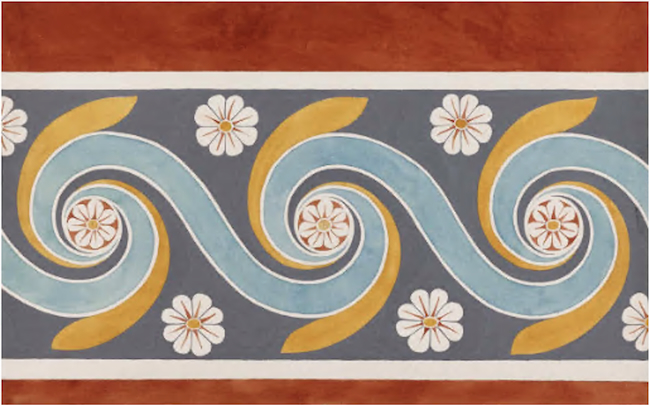
Since original ancient artifacts could not be transported to the exhibition in London, the displays consisted of replicas of ancient artifacts, modern ethnographic artifacts and illustrative panels with original watercolour drawings, many of which were done by Émile Gilliéron and Piet de Jong, and photographs.
The 1936 Exhibition Collection contains the surviving panels with original artwork from this exhibition.
The original description in the catalogue reads: "Mummers on May Day on Mount Pelion, Thessaly... The Death of the Old Man."
The original description in the catalogue reads: "Mummers on May Day on Mount Pelion, Thessaly… The Arrival of the Doctor."
The original description in the catalogue reads: "Mummers on May Day on Mount Pelion, Thessaly... The Doctor at work, restoring the Old Man to life."
Cut up card base with four images attached. Three of the images are labelled with the pasted letters b-d; the letters b and c have lines drawn over them in pencil. To the right of the unlabelled image is a slightly paler square where there could have been a label. In the lower left corner of the leftmost panel is a paler square with some residue, where a panel number may have been removed. The panel with an unlabelled image (1936/01/04/02/01) has an 8 in a diamond in pencil in the lower left corner. The panel labelled c (1936/01/04/02/02) has a 10 in a diamond in pencil in the top right corner. The panel labelled b (1936/01/04/02/03) has a 9 in a diamond in pencil in the lower left corner, a 56 in blue pencil in the lower right corner, which has been crossed out in pencil and 55 written beside it, and to the right of the label is 2/1 written in biro. The panel labelled d (1936/01/04/02/04) has 104 d in pencil in the top right corner and a bibliographic reference beneath it. The original description in the catalogue reads: "a. Bronze mirrors with (b) carved ivory handles, from the woman's grave in the entrance passage of the "Tomb of Clytemnestra," L.H. III (1400-1100 B.C.). c. Ivory inlay from a wooden casket, from Tomb 518, L.H. II (1500-1400 B.C.). d. Fragments of ivory plaque (restored drawing), showing guardian lions in heraldic posture, from "Tomb of Aegisthus," L.H. II (1500-1400 B.C.).”