

About the BRF Collection
The Byzantine Research Fund Archive (BRF) is a unique collection of architectural drawings, photographs and notebooks created from the late 19th century to the middle of the 20th century by a small team of British architects trained in the Arts & Crafts tradition whose studies of Byzantium shaped the Byzantine Revival in later years.
The collection contains over 1,500 drawings and 1,000 photographs, numerous notebooks and the corporate records associated with the Byzantine Research and Publication Fund, the original body created in 1907 to support this work. Although the Fund was associated with the BSA from the time it was founded, it was not until 1937 that the BSA formerly took over the property and operation of it. The BRF Archive contains records of Byzantine monuments in Greece, Turkey, Italy, the Near East, Egypt, and Cyprus. In some cases, the collection contains the only record of a monument before its destruction in modern times, the most important example being the church of Hagios Demetrios in Thessalonike which was almost completely destroyed in the Great Fire of 1917 shortly after being recorded by one of the BRF architects, Walter Sykes George. It also contains personal records of the following architects; Robert Weir Schultz, Sidney Howard Barnsley, Walter Sykes George, William Harvey, Harold Swainson, Peter Gus Corbett, and A.H.S (Peter) Megaw. The aspirations of the BRF Archive Project today are to make these materials accessible to a wide range of researchers.

North tower (west front). This is a Hellenic Society photograph. It is numbered (H.S. 1808) and annotated in pencil at the back. Dyer?(donor), Macmillan and L
South side. The photograph is annotated in pencil at the back.
Distant view. This is a commercial photograph. Creator unknown.
View of the iconostasis. The photograph is annotated in pencil at the back. Creator unknown.
South view. The photograph is mounted and framed. It is signed and dated in ink at the back. Further annotation in ink survives.
East façade. The photograph is mounted and framed. It is signed and dated in ink at the back. Further annotation in ink survives.
South-east view. The photograph is mounted and framed. It is signed and dated in ink at the back. Further annotation in ink survives.
East façade. The photograph is mounted and framed. It is signed and dated in ink at the back. Further annotation in ink survives.
General view. The photograph is dated and annotated in pencil at the back.
General view. The photograph is dated and annotated in pencil at the back.
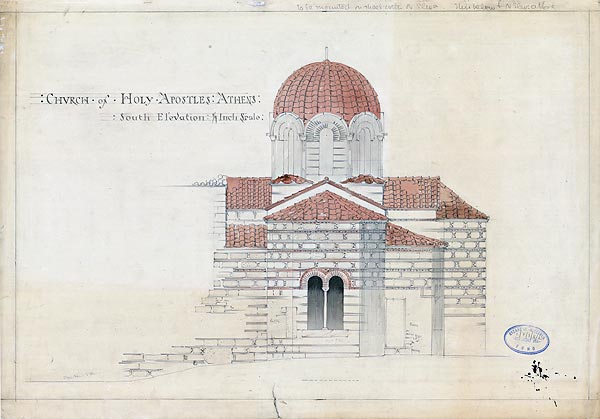
East elevation. This elevation depicts partly the five horizontal dentil courses of the church (an uppermost dentil cornice runs under the roof) as well as mainly the ornamental brickwork of geometrical and Kufic/Kufesque designs which has been inserted in the vertical joints of the cloisonné masonry. An alpha (A) and omega (O) as well as a leaved cross with IC XC in the upper angles decorate the exterior wall of the central apse of the bema. The window of the east apse is triple of the 'arcade' type. Those of the side apses are double of the same type. The elevation is entitled: 'Church of Holy Apostles Athens', 'The East Elevation 1/4 Scale'. Two notes in ink survive: 'Dome modernised' next to the dome and 'Windows now filled in' delow the level of the ground floor. Further sketches in ink survive.
East elevation. This elevation offers a detailed close representation of the masonry of the east side: five horizontal dentil courses (an uppermost dentil cornice runs under the roof) as well as ornamental brickwork of geometrical and Kufic/Kufesque designs have been inserted horizontally among the courses of the bricks and in the vertical joints of the cloisonné masonry respectively. An alpha (A) and omega (O) as well as a leaved cross with IC XC in the upper angles decorate also the exterior wall of the central apse of the bema. The window of the east apse is triple of the 'arcade' type. Those of the side apses are double of the same type. The elevation is entitled in pencil: 'Church of Holy Apostles Athens'.
Panagia church: North transept, the arcade. The photogaph is annotated in pencil at the back. Initialed in pencil in the upper right-hand corner RWS.
View of interior looking east (the templon). The photogaph is annotated in pencil at the back. Initialed in pencil in the upper right-hand corner RWS.
Panagia church: The ciborium. The photogaph is annotated in pencil at the back. Initialed in pencil in the upper right-hand corner RWS.
Baptistery: view of the sculpture of the font. The photogaph is annotated in pencil at the back. Initialed in pencil in the upper right-hand corner RWS.
Carved doorway. The photograph is annotated in pencil at the back.