

About the George Finlay Papers
The George Finlay Papers contain materials created by and related to the British Historian and Philhellene George Finlay, his father John Finlay, Greek-American Philhellene George Jarvis, and British Philhellene Captain Frank Abney Hastings, dating from 1791 to 1949. Most of the collection consists of George Finlay’s meticulous records of his travels, personal and official correspondence, his personal expenditures, copious memoranda on strategy and on military and political organisation, journal entries, maps, facetiae, scrapbooks, personal notes on people—Greeks and others—and on revolutionary events, newspaper cuttings mainly on Greece and international affairs, as well as Finlay’s original manuscripts of the History of the Greek Revolution (1861) as well as corrected proofs of Finlay’s other published works.
Also included are the papers of Finlay’s father, John, two journals of Greek American philhellene, George Jarvis, and those of Finlay’s fellow British philhellene, Captain Frank Abney Hastings. The Hastings papers, which Finlay purchased in 1830, include personal and official correspondence, ship’s logs, notes that he took on board or ashore, as well as memoranda on strategy and on the naval organisation of the revolutionary forces. Collectively, these records reveal a great deal about the character, motivations, ideas, as well as the military and political judgements of these British individuals, as well as of many others, both British and Greek, with whom they interacted during the Greek War of Independence as well as many of Finlay's other interests, such as Classical and Byzantine history, natural history and politics.
5 cuttings on British Columbia, Palestine, Jerusalem and Istanbul. The Times and other newspapers. 1854-1858. Probably found loose in one of George Finlay's books.
George Finlay's bookplate stamp with his family crest, motto and signature.
Watercolour painting of corner of ceiling of Mrs Finlay's house, Athens by W. F. Knight, an architect.

Two portrait photographs of George Finlay later in life
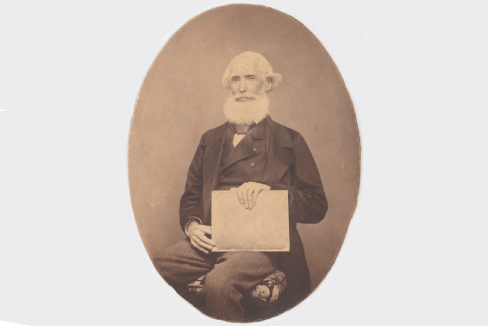
Seated portrait of George Finlay, when he is older, holding a book. Cut into oval as if it had once been frame.
Portrait photograph pasted on card of a seated older George Finlay, with interlaced hands and looking off camera. Written in pencil at the bottom in Greek is, 'Πόνσο', and on the back 'George Finlay'
59 identical engravings of George Finlay, wearing the two medals he was given for his participation in the 1821 Greek War of Independence, stored in a brown folder.
Blue mottle board, white paper spine (cracked), pp. 1-248+5 letters loose, handwritten, bound. Letters sent by George Finlay 3 January 1827-30 December 1836, varying from bare note of dispatch to complete draft of letter sent [only drafts are noted here]. With 1 newspaper clipping of an advertisement for a book.
(1) (p. 5) George Finlay to K[irkman] F[inlay]. Zante, 3 January 1827.
Unofficial appointment of Ipsilanti as king; decision of the assemblies; Miaoulis takes command of frigate. Followed by George Finlay's brief note (13 February 1827) saying that Ipsilanti was never appointed king.
(2) (pp. 5-14) George Finlay to Messrs. Ricardo. Zante, 6 January 1827.
Complaint and trouble regarding disappearance of Greek loan; need of financial backing for Greek troops; note on military organization and observations on the attitude of the Capetani to loan. State of free part of Peloponnese. The division of Greek government. Approval of Fabvier, Gordon, and Hastings. Need of money for Greece and advice on how to secure and distribute it. Description of state of Turkish fortresses.
(3) (pp. 15-17) George Finlay to the Hon. Col. Leicester Stanhope. Zante, 8 January 1827. Comment on Greek affairs; need for union and organization in Greece and among philhellenes; evil consequences of disorganization. Proposition to assist Greek navy with steamships. Request to S to use influence with Gordon and Ricardo. Observations on need for help for Greek cause and better disposal of supply of money to Greece. Importance of Greek independence for England.
(4) (p. 18) George Finlay to George Brown, Ratcliff Cross. Zante, 8 January 1827.
Request for aid for Hastings; recommendation on disposal of money by commissioners, and comments on purpose of assistance.
(5) (pp. 23-6) George Finlay to Lord Cochrane, High Admiral of Greece. Poros, 4 May 1827. Memorandum on potential revenues of Greek islands, with view to provision of supplies for the national navy. Proposal of system to assure collection of revenue and protection of the islands.
(6) (pp. 28-33) George Finlay to Col. Napier, C.B., His Britannic Majesty's Resident in Cephalonia. Syra, 23 October 1827.
Confidential opinion of affairs in Greece and organization of the Morea. Criticism and comments on foreign leaders, Church, Fabvier, Col. Heideck, Col. Pisa, and Col. Urquart. Revenues of the islands. Demoralization of Greek government. Capodistrias's establishment. Approval of Hastings's naval activities.
(7) (pp. 34-6) George Finlay to Lord Cochrane. Egina, 30 December 1827.
Confidential information on Hastings's activity in Mesolonghi, and possible destruction of Turkish vessels at Patras. Activities of Greeks in region of Mesolonghi.
(8) (pp. 39-41) George Finlay to Gibbon Fitzgibbon, Lt. Greek Artillery. Egina, 15 June 1828. Problems concerning the body and personal property of Hastings. Remarks on delivery of ship Karteria.
(9) (pp. 41-2) George Finlay to Count Capodistrias, President de la Grèce. Egina, 16June 1828. Official request that body and papers of Hastings be handed over. Indifference of Zographos to George Finlay's request re ship Karteria (in French).
(10) (pp. 44-5) George Finlay to Count Viaro Capodistrias. Egina, 6 July 1828. Complaint re insolence of Ipsariotes and retention of George Finlay's letters.
(11) (p. 49) George Finlay to Count Viaro Capodistrias. Egina, 30 September 1828
. Seeks official order for building of school in order to avoid quarrels with inhabi tants of Egina (in French).
(12) (p. 50) George Finlay to the President Count Capodistrias. Egina, 4/16 October 1828.
Re sum due to Ross, formerly servant of Hastings (in French).
(13) (p. 52) George Finlay to S. Tricoupis. Nauplia, 3 December 1828.
Informing him of receipt of draft on him as Secretary of State from Barff and Hancock of Zante.
(14) (p. 53) George Finlay to Thomas Gordon of Cairness, Napoli. Egina, 2 February 1829. Concerning arms, books, and other effects of Hastings.
(15) (p. 55) George Finlay to Thomas Gordon. Egina, 27 February 1829. Request for return of Hastings's sword.
(16) (p. 58) George Finlay to Count Capodistrias, le Président de la Grèce. Egina, 12 June 1829. Request for payment of sum due to Hastings for maintenance of Karteria before victory of Salona and capture of Vasiladi (in French).
(17) (p. 65) George Finlay to Count Capodistrias. Egina, 18 November 1829.
Requests authority to take charge of sum due to Hastings's heirs (in French)
. (18) (p. 66) George Finlay to Count Capodistrias. Egina, 25 November 1829.
Request for grant of Greek citizenship (in French).
(19) (p. 68) George Finlay to Count Capodistrias. Egina, 21 December 1829.
Request for settlement by Greek government of sum due to Hastings's heirs (in French).
(20) (pp. 68-9) George Finlay to Count Capodistrias. Egina, 26 December 1829.
Further request for grant of Greek citizenship.
(21) (pp. 70-2) George Finlay to Captain E. Scott, George's Street, Croydon, Surrey. Egina, 29 December 1829.
Explanation of cause of delay over receipt of sum due to Hastings by Greek government; troubles over proof of Hastings's will due to Greek law; Hane and Kalergy (Kallergis) disclaim hostile proceedings, but oppose dispatch of Hastings's effects to England.
(22) (pp. 72-4) George Finlay to the Revd. Wm. McDouall, Luton, Bedfordshire (under cover to Geo. Hawthorn, 33 Old Broad St., London). Egina, [31 December 1829]. Explanation of involved legal procedure preventing execution of Hastings's will under English law without previous proof in Greece; George Finlay's wish to abide by terms of H's will.
(23) (p. 79) George Finlay to E.J. Dawkins, H.B.M. Resident in Greece. 13 April 1820.
George Finlay offers services should British government wish to employ persons in Greece for furtherance of Treaty of 6 July 1817.
(24) (p. 86) George Finlay to Messrs. Lee and Sons, Smyrna. 19 October 1830.
Re money at his disposal at Smyrna.
(25) (pp. 87-8) George Finlay to Mr. Cirkis Askerian, Pera, Constantinople. 21 October 1830.
Re Mrs. Finlay's property in Constantinople.
(26) (pp. 101-3) George Finlay to G. Gropius, Austrian Consul General, Nauplia. 15 January
1832. Charges for repairs to George Finlay's house. Rumours of Russian influence.
(27) George Finlay to Schaubert and Cleanthes, Architects. Athens, 24 March 1832.
Thanks for assistance in construction of George Finlay's house; payment for services (in French) ; (loose sheet inserted between p. 107 and p. 108).
(28) (pp. 108-10) George Finlay to ( ? G. Gropius). 21 October 1832.
Complaint re unjust measures of Bey commanding Athens against landowners in Attica; unfair tax on olives and prohibition on private sale of grain.
(29) (pp. 110-11) George Finlay to the Revd. J. H. Hill. 13 November 1832.
Terms of sale of land of Ali Rhiga.
(30) (pp. 119-20) George Finlay 'an die Königliche Regentschaft von Griechenland zu Nauplia'. Athens, 10/30 May 1833.
Requests nomination as Royal officer ('officier à la suite') for services during Greek War of Independence (in German).
(31) (p. 122) George Finlay 'à Son Altesse le Prince de Saxe Altenburg, Chef du Royal Gouvernement Militaire, Nauplia'. Athens, 7 July 1833.
Request for agreement to George Finlay's nomination as Captain of the Greek Army (Capitaine à la suite) (in French).
(32) (pp. 123-4) George Finlay 'à Son Excellence le General van Heideck. Athens', 12 July 1833. Thanks for assistance in George Finlay's nomination as 'Capitaine à la suite' (in French).
(33) (pp. 125-6) George Finlay to the Royal Ephor of Attica, George Lasanes. Athens, 24 July 1833.
Complains that tenants of George Finlay's property at Liossia, Dimitraki Chatzi Petros and Chatzi Tzikakes, refuse to pay the percentage on the revenue from acorns (in Greek).
(34) (pp. 127-8) George Finlay to the Magistrates' Court, Syra. Athens, 11/13 October 1833. Appointment of Konstantinos Stratoudakes as George Finlay's attorney in Syra (in Greek).
(35) (p. 129) George Finlay to the Police Station, Athens. Athens, 12 October 1833.
Re theft, with request for action (in Greek).
(36) (p. 133) George Finlay to Prince Caradza. 6 June 1834.
Psyllas accused of giving false information re child abandoned on George Finlay's doorstep.
(37) (p. 134) George Finlay to Mavrocordatos. 10 June 1834.
States his claim for honours, if any are to be conferred, by reason of services in war of independence and aid towards consolidation of the Greek monarchy.
(38) (p. 135) George Finlay to Lt. Slade, R.N. 12 June 1834. S accused of making false statement.
(39) (p. 136) George Finlay to J. Kolettes, Minister of lnterior. 10 July 1834.
Thanks K for his nomination as 'Commissaire extraordinaire du Gouvernement' to assist Nomarch of Athens in planning of city and to advise Count Klenze.
(40) (pp. 137-41) George Finlay to M. Theocharis, Secretary of Finance. Athens, 22 August 1834. Complaint against Forestry Administration for Attica re felling of timber on George Finlay's property at Lyosha [Liossia]. Suggestions for agricultural measures and for financial support for reconstruction of devastated villages of Roumelia. Remarks on protection of private woods and collection of acorns. Offer of personal financial assistance if government takes suitable measures (in French).
(40a) (pp. 141-3) [no address or title] 2 September 1834. In French.
Complaint re decision of Ephor of Attica to fell timber on private estates. Demand for investigation. Fear expressed that the proprietors of 'tchiftiks' will abandon land.
(41) (pp. 143-5) George Finlay to the Nomarch of Attica. Athens, 5 September 1834. Complaint re non-receipt of title deed of property at Liossia; comments on unsatisfactory agricultural situation arising from governmental indifference. In French.
(42) (p. 146-148) George Finlay to James Russell, No. 2 Old Court, Lincolns Inn. Athens, 16 September 1834.
Order for books.
(43) (pp. 151-3) George Finlay to J. Kolettes, Secretary of State for Ministry of lnterior. Athens, 20 September 1834.
George Finlay's activity in connection with plan of Athens; purpose of plan; government and municipal assistance. System of town planning in America and England (in French).
(44) (p. 155 (loose) ) J. H. Hill to George Finlay. n.d. (? 1834).
Re George Finlay's subscription to 'Galignannis' which has run out (with part draft on back in French dated 4 October 1834 re George Finlay's intention to set up model farm and proposed barracks; see no. 46).
(45) (p. 155 (loose)) George Finlay to A. Kleomenes. Athens, 1 November 1834.
Re George Finlay's resignation as member of Town Planning Commission.
(46) (p. 155 (loose) ) George Finlay to 'Monsieur le Capitaine'. November (?) 1834.
Re decision to establish barracks on George Finlay's property in Patissia St. near Hartmann's house, on the occasion of transfer of Greek government to Athens; request for compensation.
(47) (p. 155 (loose) ) George Finlay to Mayor of Athens, Anargyros Petrakis. Athens, 1/15 June 1835.
Thanks for gift of medal struck by Municipality on occasion of His Majesty's accession (in Greek and English).
(48) (p. 163) George Finlay to Baron de Rheineck. 6 January 1836.
Refuses de Rheineck's offer to buy Finlay's property in Egina for 5,000 dr.; would accept 6,ooo dr.
(49) (pp. 163-73) George Finlay to H. Robinson, J. Hodgson, T. Spring Rice (Treasury), Lord Palmerston (Foreign Office). 24 January 1836.
Memorandum on establishment of banks in Greece; on contract between Greek government and Mr. Glass; desirability of interest of British bankers; hope of improvement in Greek financial situation despite low revenue and lack of organization. Armansperg's measures ineffective. Deterioration of the army.
(50) (pp. 174-5) George Finlay to Mr. Theocharis, Secretary of State in Department of Finance. 1 February 1836.
Complaint re illegal collection of acorns on George Finlay's property at Elaioussa [Liossia] in Attica.
(51) (pp. 176-7) George Finlay to Sir Edmund Lyons. 13 February 1836.
Request for intervention to obtain titles of property at Lyosha [Liossia] from the Greek government according to protocol of the three Protecting Powers dated 22 March 1829.
(52) (pp. 177-81) George Finlay to Lord Palmerston (with another letter with same subject deleted). Athens, 22 February 1836.
Request for assistance in obtaining the title deeds of his property; difficulties because of loss of Turkish deed ('hodjet'); copies of letters to Lyons, and Lyons's answer enclosed [first draft (pp. l77-80) deleted, followed by shortened version (pp. 180-1)].
(53) (pp. 182-3) George Finlay to Count Armansperg, Chancellor of Greek Kingdom. Athens, 10/22 February 1836.
Complaint re appropriation of land belonging to George Finlay for construction of royal palace; request for early compensation (in French).
(54) (p. 183) George Finlay to Nomarch of Attica. Athens, 21 February 1836.
Explanation of reason for George Finlay's resignation from membership of tax commission.
(55) (pp. 185-6) George Finlay to General Schmaltz, Minister of War. 28 March 1836. Agreement not to resign from Greek army, with request for same pay as officers of the Phalange.
(56) (p. 186) George Finlay to Lord Palmerston. 9 April 1836.
Copy of memorandum re general administration of kingdom sent to king of Greece, with request for Palmerston's opinion on contents.
(57) (p. 187) George Finlay to Mr. Lassanis, Secretary of State of Department of Finance. 2/14 April 1836.
Request for compensation for damages to George Finlay's property at Elaiousa [Liossia] in 1834.
(58) (pp. 188-9) George Finlay to G. Psychas, Syra. 8 May 1836.
George Finlay unable to help Psychas because of personal financial difficulties.
(59) (pp. 190-9) George Finlay to Hancock. 30 May 1836.
George Finlay's views on establishment of English Bank in Greece; problem of inexperience and ignorance of Greek government and people; necessity of carefully defined bank law. Criticism of Armansperg's legislative and administrative authority. Disappearance of banditry, but increase of irregular troops; Church unable to intervene.
(60) (pp. 200-3) Copy of Power of Attorney sent to George Finlay by Capt. Copeland. Malta, 25 May 1836.
Power of Attorney made in Malta, 25 May 1836, by Capt. Richard Copeland, before Notary Public, appointing George Finlay to manage, direct, and represent him legally in respect of his property of Vromassa in Negroponte (Euboia).
(61) (p. 203) Testimony of Charles Curry, Notary Public, Malta. Malta, 25 May 1836. Power of Attorney given by Capt. Richard Copeland is confirmed by Greek Consul in Malta, Thomas MacGill (in Italian).
(62) (pp. 204-6) Statement of Capt. Richard Copeland before Greek Consul of Malta, T. MacGill. La Vallette (Valetta), Malta, 25 May 1836.
Re property at Vromassa in Euboia, purchased 6 May 1831. C does not delegate authority to agent Mr. Lapierre.
(63) (p. 206) Plenipotentiary of Ottoman Empire, Hadji Ismail Bey. June (?) 1836. Plenipotentiary attests legal purchase of Capt. Copeland's property near village of Vromassa in Negroponte (Euboia), 6 May 1831 (in French).
(64) (pp. 208-11) George Finlay to Sir Edmund Lyons, H.B.M. Minister Plenipotentiary in Greece. 15 August 1836.
Copy of George Finlay's memorandum to Greek government regarding prices fixed for sale of valania (oak) trees (acorn-crop). Complaint re unreasonable discrimination as between Greek and Turkish properties.
(65) (pp. 211-15) English translation of memorandum to Greek Minister of Finance. 2/14 August 1836.
See no. 66.
(66) (p. 215) George Finlay to general lessee of acorn crop in Attica Mr. Panagiotis Lazaras. Athens, August 1836.
Request that L pay tax for acorn crop on his property at Liossia, according to clause 4 of decree of June 1836.
(67) (pp. 215-19) George Finlay's memorandum to Greek Minister of Finance. 2/14 August 1836. Grounds for modification of Greek government regulation concerning tax on oak trees; request for establishment of single price for Greek and Turkish properties; in case of damage purchaser of Turkish property must be indemnified by the Turkish seller, according to the protocol of the Allied Powers of 22 March 1829 (in Greek).
(68) (pp. 219-21) George Finlay to Governor of Attica. Athens, 3/15 August 1836.
Re legal rights of George Finlay's property at Liossia; complains of unfair and illegal collection of acorn crop by peasants of Menidi; request for action.
(69) (pp. 222-3) George Finlay to Mr. Rizo, Secretary of State for Education and Religion. 9-10 August 1836.
Request for regular and prompt payment ofrent for George Finlay's house. Statement of George Finlay's financial difficulties resulting from arbitrary collection of acorns by peasants on his property.
(70) (pp. 224-5) George Finlay to M. Lassanis, Minister of Finance. Athens, 13/22 August 1836. Request for compensation for loss of revenue from acorn collection on George Finlay's property at Liossia.
(71) (pp. 225-6) George Finlay to Robinson, Patras. 25 August 1836.
Re publication of law concerning Greek Bank; excessive dependence of Greeks on government; exile of army officers; measures of the government; political trial of Skoufo provoking commotion; expression of disapproval regarding Armansperg's public holiday. Further references to illegal acorn-crop collection and damages caused on George Finlay's property.
(72) (pp. 227-30) George Finlay to Sir Edmund Lyons. 26 August 1836.
Thanks for intervention over the acorn tax; complaint over Greek government's decision requesting George Finlay to pay more tax than Greek proprietors; request of modification of law in his favour, otherwise matter will be submitted to counsel in England.
(73) (pp. 231-5) George Finlay to Sir Edmund Lyons. 27 August 1836.
Regret over government neglect of agriculture law; objection to taking case to Mixed Commission, as proposed by L; George Finlay's rights over his oak trees.
(74) (pp. 235-7) George Finlay to Sir Edmund Lyons. 31 August 1836.
Dissatisfaction at L's proposal to carry George Finlay's affair to the Mixed Commission; defence of his legal rights; reference to his services to Greek nation.
(75) (pp. 238-9) George Finlay to John Hodgson, London. 6 September 1836.
Request to submit, as soon as possible, George Finlay's Memorandum to Lord Palmerston. Disagreement with Lyons and Greek government. Reference to George Finlay' services to the London bankers in connection with Greece; view on Armansperg's unfair policy; suggestion to remove legislative authority from Armansperg's ministry.
(76) (pp. 240- 1) George Finlay to Mr. Frey, Councillor of H.M. Cabinet. 16 September 1836. Wishes to know whether he desires renewal of tenancy of George Finlay's house.
(77) (pp. 242-3) George Finlay to H.R. 20 December 1836.
Copies of George Finlay's correspondence with Lyons; request for Palmerston to be shown George Finlay's memorandum. Accuses Bavaria and Austria of tyrannical policy in Greece. British subjects left without protection; threat to bring case to Parliament if the present English administration remains indifferent.
Blue mottle boards, brown calf spine, 'Correspondence' on spine, bound, pp. 1-70+4 loose items (9, 31, 40, 58), handwritten. Letter book 20 January 1837-28 November 1849.
(1) (pp. 9-10) George Finlay to J. Backhouse, Under-secretary of State for Foreign Affairs. 29 January 1837.
Greek agricultural law and taxes imposed by Greek government on acorn crops in private ownership; George Finlay's apology for trouble caused to Palmerston on this subject.
(2) (p. 10) George Finlay to Sir Edmund Lyons. 29 January 1837. Expresses esteem for L.
(3) (pp. 10-11) George Finlay to E. [?C.] Lyall, Foreign Department of the Geological Society, Somerset House, London. 25 February 1837.
Sends duplicates of fossil bones found by George Finlay at Pikermi; the originals are in Museum of Natural History at Athens; topographical remarks on the place of discovery; hopes for complete excavation.
(4) (p. 12) George Finlay to Major General Schmaltz, Minister of War. 31 May 1837. George Finlay's petition to resign as Major 'à la suite' (in French).
(5) (pp. 12-13) George Finlay to Rudhart, Minister of King's Household and of Foreign Relations. 16 June 1837.
Thanks king for receipt of Gold Cross of the 'Chevalier de Son ordre royal du Sauveur' conferred in consideration of services to Greece (in French).
(6) (p. 13) George Finlay to David Dundas, Brookes's Club, London. 21 June 1837.
State of Greece; Austria's influence provokes Rudhart's fall; Greek loan remains unpaid; financial difficulties of Greek government.
(7 and 8) (pp. 13-14) George Finlay to Baron de Stengel, Secretary of the King's House. 10/22 June 1837. 2 July 1837.
Two letters re indemnity for damages caused by Councillor Frey, tenant of George Finlay's house (in French).
(9) (p. 15) George Finlay to Sir Edmund Lyons, H. M. Minister Plenipotentiary in Greece. 2 August 1837.
Re title deeds of George Finlay's houses in Athens deposited in archives of British Legation.
(10 and 11) (pp. 17-18) George Finlay to Director of Archaeological Institute at Rome, and to Emilio Braun, Secretary of the Institute. 19 May 1838.
Two letters of thanks for election as Corresponding Member of Institute. Promise to send notices of Attic topography and of Persian arrowheads.
(12) (p. 19) George Finlay to Messrs. Burdin and Co., Milan. 6 September 1838. Order for plants (in French).
(13) (p. 20) George Finlay to Mr. Roberts, Syra. 18 September 1838.
Account of archaeological activity in Greece since Revolution.
(14) (p. 20) George Finlay to Sir Edmund Lyons. 22 September 1838.
Requests assistance in obtaining indemnity for property occupied by Greek government.
(15) (pp. 20-2) George Finlay to Chevalier de Heidenstam. 29 September 1838.
Difficulty of obtaining indemnity for land on which Royal Printing Office has been built, in which George Finlay has a two-fifths share, H three-fifths; George Finlay is applying to British Legation for support (in French).
(16) (p. 23) George Finlay to General T. Gordon. 14 October 1839.
Regrets inability to keep agreement to rent G a room in house at Liossia; returns G's payment with interest and hopes that G will not take the legal action threatened.
(17) (p. 25) George Finlay to Chevalier de Heidenstam. 7 April 1840.
George Finlay agrees to concede rights over land at Stadion St. in return for 6,000 dr. (in French).
(18) (p. 25) George Finlay to Director of Archaeological Institute at Rome. 21 May 1840. Again expresses appreciation of nomination as Corresponding Member of the Institute (cf. nos. 10 and 11 , above) ; failure to dispatch regular communications due to lack of material.
(19) (p. 26) George Finlay to Emilio Braun, Secretary of Archaeological Institute at Rome. 21 May 1840.
Will send archaeological communications from Greece when possible, though at present little activity in history, archaeology, or fine arts and Archaeological Society is not very flourishing. Regrets that Ross is not at present a member of it.
(20) (pp. 26-7) George Finlay to Rejoice Newton, Secretary of the American Antiquarian Society. 22 May 1840.
Expresses gratitude for diploma and election as member of the A.A. Society.
(21) (p. 27) George Finlay to Governor of Attica. 30 May 1840.
Re illegal usage of pasture ground at Maounais belonging to George Finlay as part of the tchiflik at Liossia (in French).
(22) (pp. 28-9) George Finlay to E. Braun. 9 August 1840.
Re two scarabs with inscriptions, found at Egina. Regret at the sudden death at Delphi of Chevalier C. O. Muller of Göttingen.
(23) (p. 30) George Finlay to John Green. 12 September 1840.
English church in Athens intended for divine service according to Church of England but property should be vested in representatives of British government.
(24) (pp.30--3) George Finlay to Robert Pashley (c/o J. Murray, Albemarle St., London). 5 April 1841. Requests interest in Cretan cause; examination of Cretan problem; need to assist Cretan population.
(25) (p. 33) George Finlay to Secretary of Natural History Society of Greece. 7/25 March 1841. George Finlay's resignation from Society (in Greek).
(26) (p. 33) George Finlay to Chief Royal Forester of Attica. Athens, 3/15 May 1841. Agreement for felling timber on George Finlay's property at Liossia.
(27) (pp. 34-5) George Finlay to Sir Edmund Lyons. 30 August 1841. Disputes re boundaries of George Finlay's property at Liossia.
(28) (p. 36) George Finlay to Mimis, Secretary to Ministry of Finance. 24 January 1842. Requests ratification of agreement signed before a notary concerning George Finlay's land at Piraeus.
(29) (pp. 36-7) George Finlay to Sir Edmund Lyons. 25 January 1842.
Requests L's intervention Greek government to obtain indemnity for Finlay's land taken to form part of the Royal Palace ground.
(30) (p. 38) George Finlay to Minister of War. 21 March/2 April 1842.
Asks whether dispatch of diploma and medal conferred by King Otho can be expedited owing to his imminent department (in French).
(31) (16-page notebook, loose at pp. 38-9).
List of letters sent 29 July 1842-23 August 1843.
(32) (p. 39) George Finlay to Sir Edmund Lyons. 16 April 1844. Claim for indemnity. See no. 29.
(33) (pp. 40-1) George Finlay to the Revd. J. H. Hill. 21 July 1844.
Re administration and upkeep of Protestant cemetery in Athens and adequate remuneration of custodian.
(34) (p. 42) George Finlay to Philip Green, London. 27 August 1844.
Mistake in books dispatched to George Finlay; request to exchange these for others on list enclosed.
(35) (p. 43) George Finlay to John Green, Manager of the Commercial Bank of Piraeus at Patras. 14 September 1844.
George Finlay offers no observations as Inspector of Accounts on G's arrangements with Gordon.
(36) (pp. 42-3) George Finlay to Gen. Sir Richard Church. 18 September 1844.
Announcement of Hane's death; caustic criticism of Mavrocordatos's treatment of him; Greek government should assist family.
(37) (pp. 43-5) George Finlay to C. H. Bracebridge, Atherston, Warwickshire. 25 September 1844.
Hope that Chadwick's proposal for water supply of Athens will be accepted by municipality or government. Criticism of Greek politicians; political state of Greece; reasons for Mavrocordatos's unpopularity; his unjust behaviour to Hane. Lyons's failure to assist Hane.
(38) (p. 46) George Finlay to Edward Masson, Judge of the Supreme Court of Greece. 24 January 1845.
George Finlay condemns apparent accusation against M in Morning Post.
(39) (p. 47) George Finlay to James MacGregor, Banker, Liverpool. 18 September 1845.
Sends first part of his work on Greece for publication; he hopes to make his next on Syria, Palestine, and Egypt.
(40) (loose between p. 48 and p. 49) Aristides [George Finlay] to the editor of the Liverpool Courier.
Athens, 6 February 1845.
Denounces H. W. Dewhurst for publishing Professor Young's 'Analytical lecture on Gray's Elegy' as his own.
(41) (p. 49) George Finlay to John Green. Athens, 14 May 1846.
Re G's tenancy of George Finlay's house.
(42) (pp. 50-2) George Finlay to John Blaikie, Advocate, Aberdeen. Athens, 9 June 1846.
George Finlay has found books of the Commercial Bank of Athens under the management of John Green to be in order. Detailed inspection of Patras branch would necessitate personal visit. Ionian Bank has established agency at Athens and may compete with Commercial Bank. Insecurity of property in Greece and deterioration of Law Courts.
(43 and 43a) (p. 53) George Finlay to C. H. Bracebridge, Athenaeum Club, London. 9 June 1846, 30 June 1846.
Two letters re George Finlay's essay on the various races in ancient and modern Greece.
(44) (p. 53) George Finlay to Mr. Moussouri, Corfu. 1/13 September 1846.
Re payment of George Finlay's debt to Miss Theonitza.
(45) (pp. 53-6) George Finlay to John Blaikie, Advocate, Aberdeen. Athens, 18 September 1846. After careful inspection of account of Commercial Bank George Finlay considers that Mr. Green should separate management of Commercial Bank from agency of Ionian Bank; details reasons for this recommendation.
(46) (p. 57) George Finlay to C. Moussouri, Corfu. Athens, 18 September 1846. George Finlay's difficulties as trustee re transfer of sum owed to M's wife.
(47) (p. 58) George Finlay to J. Green, Manager of the Commercial Bank. 23 October 1846. Asking for copies of balance sheet of Commercial Bank and list of overdue bills.
(48) (p. 58) George Finlay to James Robertson, Smyrna. 30 October 1846.
Re unsuitability of either George Finlay or Green to be managers of Commercial Bank since they are both small shareholders.
(49) (p. 58) George Finlay to John Green, Manager of Commercial Bank. 28 October 1846.
As shareholder of Commercial Bank Finlay protests at G's failure to supply documents requested; G's duty to call a meeting of shareholders.
(50) (pp. 59-60) George Finlay to John Blaikie, Advocate, Aberdeen. Athens, 31 October 1846. George Finlay sends copy of his correspondence with Green, manager of Commercial Bank. G's hostility due to George Finlay's opposition to proposed union of Ionian and Commercial Banks. George Finlay hopes Directors will wish him to retain his Inspectorship of the Accounts of the Bank; if not he wishes to sell his shares.
(51) (pp. 60-1) George Finlay to John Green, Manager of the Commercial Bank of Piraeus. Athens, 31 October 1846.
George Finlay again requests permission to inspect books and accounts of Commercial Bank as Inspector of Accounts and a shareholder.
(52) (p. 63) George Finlay to W. Blackwood and Sons, Edinburgh. 30 March 1847.
Has already sent a paper on Belisarius and now encloses 'Crossing the desert'.
(53) (p. 65) George Finlay to Soutsos, Nomarch of Attica and Boeotia. Athens, 23 July/4 August 1847.
Sends his resignation from District Council for reasons of health (in Greek).
(54) (pp. 65-6) George Finlay to Andrikos Raphiou Politis. Athens, 20 September 1847. George Finlay repudiates legal claims of his neighbour (in Greek).
(55) (p. 66) George Finlay to Philip J. Green, London. 19 November 1842.
Re dispatch of magazines and books.
(56) (p. 67) George Finlay to John Green, English Consul, Athens. Athens, 14/26 February 1848.
Re parcel sent from London which has not yet reached him.
(57) (p. 68) George Finlay to A. R. Rangabes, Secretary of Archaeological Society of Athens. November 1848.
Expresses gratitude for diploma and nomination as Corresponding Member of Archaeological Society; George Finlay's financial contribution to the Society (in Greek).
(58) (loose at pp. 68-9)
Copy of no. 56 with letter in English to George Finlay.
(59) (pp. 69-70) George Finlay to Nast, Bookseller, Athens. 28 August 1848.
Re failure to send books and defects in those already received.
Red leather, 'Letters' pasted on spine, bound, unpaginated +5 loose sheets: handwritten, printed cuttings giving postal rates pasted in, bound.
Letter Book 27 January 1850-27 December 1866.
List of letters dispatched by George Finlay with occasional brief note of contents (only drafts noted here).
Meteorological notes 2 December 1827-23 June 1869.
(1) George Finlay to Printer of Medieval Greece and Trebizond. Athens, [20 February 1851]. Instructions re printing of work.
(2) George Finlay to Messrs. Blackwood and Sons. Athens, 20 February 1851.
Wishes to keep cost of Medieval Greece and Trebizond to not more than 12s.
(3) George Finlay to G. Muir, 247 Strada Reale, Booking and Superintending Agent to H.M. Packets in the Mediterranean, Malta. 8 February 1851.
Re dispatch and payment for MSS. and books sent to James MacGregor.
(4) George Finlay to John Grant Esq., or Messrs. Peter Stuart and Co., Malta. Athens, 28 Feb ruary 1851.
Re dispatch of manuscripts and books to England.
(5) George Finlay to Messrs. Blackwood and Sons. 28 February 1851.
Re dispatch of MS. of Medieval Greece and Trebizond via Malta. Desires speedy publication.
(6) George Finlay to A. Maresecq, Paris. Athens, 22 February 1851. Refusal to pay sum demanded (in French).
(7) George Finlay to the Revd. R. Cattermole, Secretary of the Royal Society of Literature. Athens, 22 March 1851.
Expresses gratitude for his election as Honorary Member of the R.S. of Literature.
(8) George Finlay to Lord Palmerston, 4 Gloucester Square. 24 July 1851.
Expresses gratitude for P's support in his attempt to obtain justice from King of Greece.
(9) George Finlay to Clark. Athens, 27 September 1861.
Re terms of admission of English printed papers into Greece (loose).
(10) George Finlay to the Revd. G. Phillips, Vice-Chancellor of the University of Cambridge, President of Queens' College. Athens, 17 May 1862.
Expresses gratitude for the honorary degree of LL.D. conferred by University; regrets impossibility of receiving this in person.
Black cloth board, calf spine and corners, spine broken, tied together with string, bound; paginated in part at random, bound, with many loose sheets. The letters are frayed at edges and in poor condition; they are 'carbon' copies of letters sent by George Finlay 1852-4, 1858-9, 1861, and 1867, together with drafts of articles and notices of books; pagination noted where it exists.
(1) (3 pp. loose) George Finlay to J. P. Schilizzi Junr., Liverpool. Athens, 29 November 1860.
Re purchase of clothes in England.
(2) George Finlay to M. A. Durand, 7 rue des Grès, Sorbonne, Paris. Athens, 20 December 1860.
Re subscription to Revue des deux mondes and payment for books (in French).
(3) (1 p.) George Finlay to Librarian of Oxford Union Debating Society, Oxford. Athens, 19 December 1860.
Re Union's subscription to Elpis.
(4) (p. 1) George Finlay to Messrs. Blackwood and Sons, Edinburgh. Athens, 3 January 1861.
Re corrigenda to be made in George Finlay's MS. of his History of the Greek Revolution.
(5) (pp. 2-3) George Finlay to Messrs. Blackwood and Sons, Edinburgh. Athens, 13 March 1861.
Submits paper on Ottoman Empire for publication.
(6) (pp. 3-59 with two loose sheets) George Finlay to [?]. 1861.
Draft of paper 'The Euthanasia of the Ottoman Empire' [published in Blackwood's Edinburgh Magazine, no. 547, May 1861, vol. 89, bound in George Finlay's Greek Papers, FIN/GF/E/38 (211)].
(7) (pp. 60-6) George Finlay to Editor of Athenaeum. Athens, 18 September 1861.
Submits notice on J. G. von Hahn's work, Reise von Belgrad nach Saloniki, published in Memoirs of Historical Section of lmperial Academy of Vienna, vol. xi, published separately, Vienna, 1861. Advantages of H's proposed railway. H also notes increasing Albanian population; value of H's geographical and ethnological observations.
(8) (p. 67 +1 sheet attached) George Finlay to [?]. Athens, 15/27 September 1861.
Regret at not being able to assist. Complains of neglect of Greek government (in Greek).
(9) (pp. 68-78) George Finlay to Professor C. C. Felton. Athens, 26 November 1861.
Re difficulties of travelling to Greece. Comments on American Civil War. Reference to George Finlay's History of the Greek Revolution and to modern Greek sculpture. Autobiographical sketch of George Finlay. Wishes to acquire portraits of American philhellenes.
(10) (pp. 79-85) George Finlay to Professor Comnos, Athens. Athens, 27 September 1862. Discussion on unpublished Hellenistic coin in possession of C. Numismatic problems.
(11) (loose, 3 pp.) George Finlay to [?]. [? 1862].
List of books to be ordered.
(12) (pp. 284-5) George Finlay to Leicester Warren. 2 June 1866.
Thanks for patronizing George Finlay's Thoughts [about the Coinage of the Achaian League, London, 1866]; asks him to arrange for publisher to send copies to various English scholars. Remarks on some Athenian coins (as and obolos). Comments on Greek internal situation.
(13) (pp. 303-4+1 sheet attached) George Finlay to W. S. Stillman, United States Consul, Canea, Crete. Athens, 16 March 1867.
Approval of Cretan declaration of lndependence; George Finlay's opinion re foreign assistance and Cretan problem.
(14) (p. 307) George Finlay to the Revd. J. H. Hill. Athens, 28 May 1869.
George Finlay's apologies for absence from meeting of Anglo-Greek Committee.
(15) (2 loose sheets, torn) George Finlay to Messrs. W. Blackwood, Edinburgh.
Re probable publication of George Finlay's work [on the Greek Revolution]; corrections proposed.
(16) (unpaginated, 6 pp., loose) George Finlay to Editor of Athenaeum. Athens, 17 February 1854. Request to publish George Finlay's enclosed notice on J. G. von Hahn's work on Albanians recently published by Imperial Press at Vienna.
(17) (unpaginated, 3 pp. loose, end missing). George Finlay to Messrs. W. Blackwood and Sons. Athens, 28 October 1856.
Discussion of proposal to publish second edition of George Finlay's History of Greece under Romans.
(18) (unpaginated, 2 pp., loose) George Finlay to A. Durand, Bookseller, rue des Grès 5, Paris. Athens, 11 February 1858.
Acknowledges receipt of Isambert Catalogue of Coins and Medallions (in French).
(19) (unpaginated, 2 pp., loose) George Finlay to A. Durand. Athens, 18 February 1858.
Request for coins and medallions from lsambert collection.
(20) (unpaginated, 1 p., loose) George Finlay to Sculudi. [? Athens] n.d. Order for clothes.
(21) (unpaginated, 1 p., loose) George Finlay to A. Durand, 7 rue des Grès, Sorbonne, Paris. Athens, 25 March 1858.
Encloses bill of exchange in payment for coins and medallions.
(22) (unpaginated, 2 pp.) George Finlay to Demarch of Athens. Athens, 11 September 1852. Finlay's reasons for refusing to pay for repairs to his house in Odos Adrianou (in Greek).
(23) (unpaginated, 2 pp., loose) George Finlay to Demarch of Athens. Athens, November 1852. Request that police clean street between the houses of General Church and Mr. King. This is visited by all travellers of distinction and its present insanitary condition fosters disease and makes bad impression (in Greek and English).
(24) (unpaginated, 3 pp.) George Finlay to C. Moussouris, Corfu. Athens, 18/25 October 1852.
Re liquidation of Bank of Piraeus, and George Finlay's accusation against managers.
(25) (unpaginated, 2 pp.) George Finlay to Charles W. Merlin, British Vice-Consul at Athens. Athens, 7 December 1852.
Private letter re Commission formed to inquire into affair of Bank of Piraeus.
(26) (unpaginated, 2 pp.) George Finlay to C. W. Merlin, Acting Consul, Athens. Athens, 7 December 1852.
Formal letter re Commission inquiring into affair of Bank of Piraeus.
(27) (unpaginated, 1 p.) George Finlay to Messrs. Merlin and Balanos. Athens, 26 November/ 8 December 1852'.
Re Piraeus Bank affair (in Greek and English).
(28) (unpaginated, 1 p.) George Finlay to C. W. Merlin. Athens, 8 December 1852. Acknowledging second consular communication on Piraeus Bank affair.
(29) (loose, 1 p.) 6/18 September 1852.
George Finlay to General Sir Richard Church.
Asks for payment of arrears of rent owed to George Finlay.
(30) (loose, 1 p.) 6/18 September 1852.
George Finlay to General Sir Richard Church.
Asks for payment of arrears of rent owed to George Finlay.
(31) (loose, 3 pp.) 21 October 1852.
George Finlay to General Sir Richard Church.
Asks for payment of arrears of rent owed to George Finlay.
(32) (bound, 1 p.) 14 December 1852.
George Finlay to General Sir Richard Church.
Asks for payment of arrears of rent owed to George Finlay.
(33) (bound, 1 p.) 8/20 December 1852.
George Finlay to General Sir Richard Church.
Asks for payment of arrears of rent owed to George Finlay.
(34) (bound, 2 pp.) 3/15 January 1853.
George Finlay to General Sir Richard Church.
Asks for payment of arrears of rent owed to George Finlay.
(35) (bound, 2 pp.) 20 January 1853.
George Finlay to General Sir Richard Church.
Asks for payment of arrears of rent owed to George Finlay.
(36) (bound, 2 pp.) 18 February 1853.
George Finlay to General Sir Richard Church.
Asks for payment of arrears of rent owed to George Finlay.
(37) (bound, 2 pp.) 19 February 1853.
George Finlay to General Sir Richard Church.
Asks for payment of arrears of rent owed to George Finlay.
(38) (bound, 1 p.) 1/13 April 1853.
George Finlay to General Sir Richard Church.
Asks for payment of arrears of rent owed to George Finlay.
(39) (loose, 1 p.) 2/14 April 1853.
George Finlay to General Sir Richard Church.
Asks for payment of arrears of rent owed to George Finlay.
(40) (bound, 1 p.) 3/15 April 1853.
George Finlay to General Sir Richard Church.
Asks for payment of arrears of rent owed to George Finlay.
(41) (3 pp.) George Finlay to Editor of The Times, London. Athens, 7 July 1853.
Protest against agents of Austrian steam packets who illegally retain passports.
(42) (bound, 1 p.) 11/23 July 1853.
George Finlay to General Sir Richard Church.
Asks for payment of arrears of rent owed to George Finlay.
(43) (bound, 2 pp.) 12/24 July 1853.
George Finlay to General Sir Richard Church.
Asks for payment of arrears of rent owed to George Finlay.
(44) (unpaginated, 1 p.) George Finlay to Secretary of General Post Office, London. Athens, 7 October 1853.
Requests dispatch of papers by English mail from Southampton.
(45) (unpaginated, 1 p.) George Finlay to H. F. Munster, Trieste. Athens, 13 October 1853. Informs M. that Heimbach's Basilica has already been paid for.
(46) (bound, 1 p.) 4/16 December 1853.
George Finlay to General Sir Richard Church.
Asks for payment of arrears of rent owed to George Finlay.
(47) (1 p.) George Finlay to the Revd. J. H. Hill. Athens, 20 January 1854.
Request for H's good offices in obtaining information concerning activities of English and American missionaries in order to complete George Finlay's chapter in History of Greece under Foreign Domination.
(48) (bound, 2 pp.) 13/25 January 1854.
George Finlay to General Sir Richard Church.
Asks for payment of arrears of rent owed to George Finlay.
(49) (1 p.) George Finlay to M. Sculudi, Athens. Athens, 2 February 1854. Request for payment of sum due (in French).
(50) (bound, 1 p.) 8/20 February 1854.
George Finlay to General Sir Richard Church.
Asks for payment of arrears of rent owed to George Finlay.
(51) (bound, 1 p.) 22 March 1854.
George Finlay to General Sir Richard Church.
Asks for payment of arrears of rent owed to George Finlay.
(52) (bound, Ip.) 2 June 1854.
George Finlay to General Sir Richard Church.
Asks for payment of arrears of rent owed to George Finlay.
(53) (2 pp.) George Finlay to Messrs. Firmin, Didot Frères, rue Jacob 56, Paris.
Re books sent in error by George Finlay (in French).
(54) (2 pp.) George Finlay to Messrs. Firmin, Didot Frères, rue Jacob 56, Paris. Athens, 11 October 1854.
Order for books (in French).
(55) (bound, 1 p.) 18/31 October 1854.
George Finlay to General Sir Richard Church.
Asks for payment of arrears of rent owed to George Finlay.
(56) (bound, 1 p.) 2/14 November 1854.
George Finlay to General Sir Richard Church.
Asks for payment of arrears of rent owed to George Finlay.
(57) (1 p.) George Finlay to Firmin, Didot Frères, Paris. Athens, 22 November 1854.
Re payment of books purchased by George Finlay.
(58) (bound, 2 pp.) 3/15 December 1854.
George Finlay to General Sir Richard Church.
Asks for payment of arrears of rent owed to George Finlay.
(59) (loose, 1 p.) 28 December 1857/9 January 1858.
George Finlay to General Sir Richard Church.
Asks for payment of arrears of rent owed to George Finlay.
(60) (2 pp.) George Finlay to A. Durand, 7 rue des Grès, Sorbonne, Paris. Athens, 24 April 1855. Book order.
(61) (3 pp., incomplete) George Finlay to 'Excellency'. Athens, 28 April 1855.
Brigandage in Greece; George Finlay accuses Mavrocordatos, Minister of lnterior, of failure to take effective action.
(62) (3 pp.) George Finlay to Messrs. W. Blackwood and Sons. Athens, 30 May 1855.
Re addenda and corrigenda to proposed second editions of George Finlay, Byzantine History, vol. i, and Greece under the Romans.
(63) (unpaginated, 3 pp.) George Finlay to James Finlay. Athens, 30 May 1855. English lack of interest in Greek affairs; failure of allies' half measures.
(64) (2 pp.) George Finlay to Messrs. A. Durand, 5 rue des Grès, Sorbonne, Paris. Athens, 20 June 1855.
Re payment for books; list of desiderata.
(65) (3 pp., first part missing) George Finlay to [Bracebridge]. n.d. [? 1856].
Kallergis's resignation and new constitution; military government necessary to exterminate brigandage; new communal system needed.
(66) (2 pp.) George Finlay to Jonas King. Athens, 28 September 1856.
Proposal for arrangements with municipal authorities concerning street between the houses of King and George Finlay.
(67) (2 pp., one loose) George Finlay to Messrs. Halliday and Storrs, Lord St., Liverpool. Athens, 23 July 1857.
Order for clothes.
(68 and 69) (each 1 p., loose) George Finlay to Messrs. Blackwood and Sons, Edinburgh. Athens, 2 December and 3 December 1856.
Two letters concerning George Finlay's corrections for second edition of History of Greece under the Romans.
(70) (2 pp., loose, incomplete) George Finlay to Editor of Athenaeum. Athens, 16 December 1856. Athenaeum erroneously refers to George Finlay as Consul at Athens. George Finlay complains of indifference to his work.
(71) (2 pp., loose) George Finlay to Rollin, Paris. Athens, 30 December 1856.
Re payment for medallions purchased by George Finlay (in French).
(72) (1 p.) George Finlay to Librarian of Garrison Library, Corfu. Athens, 10 August 1857. George Finlay presents his works.
(73) (2 pp.) George Finlay to A. Durand, Paris. Athens, 8 April 1858.
Medallions from Isambert collection do not tally with catalogue description.
(74) (2 pp.) George Finlay to James Finlay. Athens, 8 April 1858.
Re the three allied Powers and Greek finances.
(75) (loose, 1 p.) n.d. [? April 1858]. George Finlay to General Sir Richard Church.
Asks for payment of arrears of rent owed to George Finlay.
(76) (loose, 1 p.) 4/17 April 1858.
George Finlay to General Sir Richard Church.
Asks for payment of arrears of rent owed to George Finlay.
(77) (loose, 2 pp.) 19 April/1 May 1858.
George Finlay to General Sir Richard Church.
Asks for payment of arrears of rent owed to George Finlay.
(78) (2 pp.) George Finlay to A. Durand, rue des Grès, Sorbonne, Paris. Athens, 1858.
Re items from Isambert collection purchased by George Finlay.
(79) (1 p.) George Finlay to Marinakis, Advocate. Athens, 10/22 June 1858. Acknowledges receipt of Marinakis's letter.
(80 and 81) (3 pp. and 1 p.) George Finlay to Messrs. W. Blackwood and Sons, Edinburgh.
Athens, 24 June/1 July 1859. Book orders.
(82) (5 pp.) George Finlay to Sir Patrick Colquhoun. Athens, 22 February 1859.
Agrees with English policy in Ionian Islands, but admits Ionian desire for union with Greece; comments on English attitude towards Ionian problem.
Miscellaneous paper cuttings and letters found loose in leaves of bound volumes of newspapers now in keeping of the Gennadion Library in Athens [cuttings and letters handed back to this collection January 1958]. FIN/GF/B/05/2-14 are mostly on Greek politics and Greek loan.
(2 pp.) J. R[oberston] to George Finlay. Deplores state of Greece; comments on Lyons's attitude.
Sir Edmund Lyons to George Finlay. Incomplete.
Sir Edmund Lyons to George Finlay. Undated. Incomplete.
Sir Edmund Lyons to George Finlay. Undated. Incomplete.
Sir Edmund Lyons to George Finlay. Athens, 4 September 1842. Incomplete.
Sir Edmund Lyons to George Finlay. Athens, 16 December 1843
Sir Edmund Lyons to George Finlay. Undated.
Sir Edmund Lyons to George Finlay. Undated. Incomplete.
Sir Edmund Lyons to George Finlay. Athens, 11/23 April 1844.
Sir Edmund Lyons to George Finlay. Athens, 10 July 1846.
Sir Edmund Lyons to George Finlay. Athens, 19 July 1846.
Sir Edmund Lyons to George Finlay. Athens, 1849.
Sir Edmund Lyons to George Finlay. Undated. Incomplete.
Sir Edmund Lyons to George Finlay. Undated.
[? Green] to George Finlay. Reference to George Finlay's articles in Blackwoods. Sir Edmund Lyons and the Bank.
Thomas Graes to George Finlay. Malta, 11 November (1852). Encloses printed report from Malta Times re George Finlay's paper on 'The last pages of the history of the Last Greek Republic' read to Literary and Scientific Institute of Malta.
Alexander Cochrane, House of Commons, to George Finlay. 23 May 1843. Has given notice of motion on question of Greece in House of Commons; would welcome any further information from George Finlay.
Demetrios Calliphronas to George Finlay: Athens, 15 March 1843. re financial and political weakness of Greece (in Greek).
To George Finlay. n.d. Copy of Greek constitution sent to George Finlay (in Greek).
Greek translation of Earl of Aberdeen's dispatch to Sir Edmund Lyons dated 25 November 1843, printed with two omissions in Parliamentary Papers; correspondence relating to recent events in Greece 1843-4, p. 14, no. 8. (Also extract in English.)
Extract from Lord Aberdeen's instructions to Sir Edmund Lyons, 25 November 1843.
Extract from Lord Aberdeen's private letter to Sir Edmund Lyons dated 6 December 1843.
Note on misleading nature of Sir Edmund Lyons's eulogy of Armansperg's administration in Additional Papers relating to the third instalment of the Greek loan presented to Parliament, August 1836, p. 37.
Miscellaneous newspaper cuttings including biography of Sir Edmund Lyons.
Letters 1-236 (all loose), arranged chronologically, followed by undated letters. In the Hussey catalogue, the letters were arranged into folders A-G, which covered the following dates: A: 1824-39, B: 1840-49, C: 1850-55, D: 1856-59, E: 1860-65, F: 1866-74, G: undated. In the current catalogue they are simply presented chronologically, with undated letters at the end, but the physical letters are still in folders A-G. The letters sometimes have old paper enclosures that may be annotated in Finlay's hand.
George Finlay's own letters are copies, the rest originals unless otherwise stated.
William Henry Humphreys to Col. Stanhope, Athens. Salona, 12 March 1824. Blackit has just brought a letter from Mesolonghi from George Finlay mentioning Byron's inclination to come to Athens.
Edward Blackett to George Finlay. Athens, 2 April 1824. Acknowledges receipt of money and asks about George Finlay's plans during approaching campaign.
Leicester Stanhope, Stable Yard, St.James, to George Finlay, (?) June 1825 . Praises George Finlay's sketch of Byron.
Leicester Stanhope, Stable Yard, St.James, to George Finlay, 13 July 1825. Praises George Finlay's sketch of Byron.
Sir Patrick Malcolm to George Finlay. 2 December 1831, and 28 March 1832. Two letters expressing distrust of Gropius, Austrian consul at Athens, whom he had employed to build a house there; deplores delays and growing expenses.
Sir Patrick Malcolm to George Finlay. 28 March 1832. re his house and Gropius. [See 2 December 1831.]
Thomas Gordon to George Finlay. Cairness, 26 April 1832. Pessimistic remarks re British government; fears that Greece under Capodistrias will become province of Muscovy; prospects of Prince Otto of Bavaria.
Peter Wilhelm Forchhammer to George Finlay. Nauplia, 31 August 1833. Criticism of dictatorial ways and political ignorance of Mr. Franz. Has journeyed through Peloponnese. Hopes to obtain British Admiralty map of Greek coastal waters. With an old paper enclosure.
Thomas Gordon to George Finlay. Nea Patra, 15 September 1835. re expedition against bandits in Roumeli with Turkish co-operation. Ironical comments on Gen. Church sitting in Patissia leading 'the life of Nebuchadnezzar'. Note of greeting added by C. Soutzo.
E. Hill to George Finlay. Anavrita, 22 December 1835. Apologizes for delay in returning book lent by George Finlay. With an old paper enclosure.
Charles Macintosh, Dunchattan, to George Finlay. 20 May 1836. To introduce David Dundas.
G. Gropius to George Finlay. 17 October 1836. Proposes to visit George Finlay with Prince Pückler.
Psyllas to George Finlay. Athens, 3/15 November 1836. Sends lists of Greek studying abroad.