About the Winifred Lamb Personal Papers
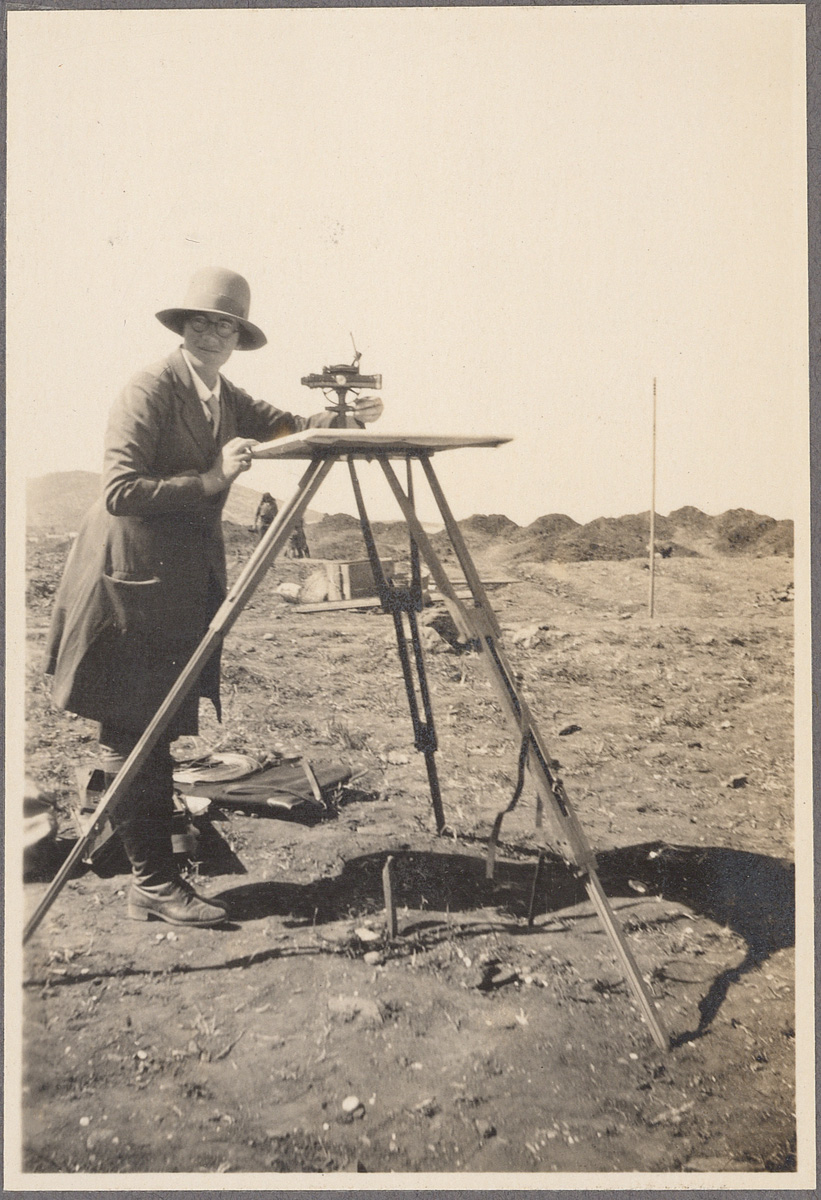
The Winifred Lamb Personal Papers largely cover the life and work of the pioneering British female archaeologist during her time in Greece and Turkey between 1918 and 1952.
The collection contains letters, a travel diary, essays, offprints, photographs and photograph albums, created by Winifred during her academic career. They especially relate to her travels and excavations at Greek sites such as Sparta and Mycenae, where she first worked as a BSA Student, and then others such as Thermi on the island of Lesvos and Kusura in Turkey, where she became the Director of the excavations- the first female BSA Student to do so. The papers also include descriptions of Winifred's time at the BSA, Greek life and significant events during this period.
Depicts unidentified ceramic figurines.

An envelope of 7 photographs of unidentified ceramic wears and vases (WL/300 – WL/306).
Depicts unidentified fragmentary ceramic figurines.
Depicts unidentified ceramic vessel. Same vessel as LAM/3/3/1/3/4.
Depicts unidentified unidentified object.
The collection contains letters, a travel diary, essays, offprints, photographs and photograph albums, created by Winifred Lamb during her academic career, between the years 1918 and c.1952. These relate to her travels and excavations at Greek sites, such as Thermi on the island of Lesvos, Sparta and Mycenae, and Turkish sites, such as Kusura. It also includes descriptions of her time at the BSA, Greek life and significant events during this period.
Depicts the square and the Venetian fountain in Iraklion, Crete. Handwritten caption: “The Square with Venetian fountain – Candia”. Also known as 'The Lion Square'.
Typewritten transcripts (with annotations/corrections) of some correspondence covering the years 1920 –c.1936, comprised of letters sent by Winifred Lamb. These contain details regarding her archaeological work and her life during this period. She mentions several colleagues, friends and people she met during her that time.
Transcript of original letter by Lamb regarding Mycenaean frescos, carnival week celebrations and parties with Stanley Casson, Mrs Wetbeg, and Mr Morton. It also mentions Schliemann’s daughter Mache Melas and Borden Wood.
Transcript of original letter by Lamb addressed to her mother concerning Easter and Good Friday celebrations, her clothes, a parcel from Sharpe, a lecture from Dorpfeld on the Acropolis and having tea with Madame Schliemann and her daughter Mme Melas (whose son is to marry Ismene Atchley). She also mentions dining with Mrs Hasluck, and on another night with Mrs Burkitts, Miles and a friend of theirs. She also mentions some of the BSA students Mr and Mrs Heurtley, the Frinches, Mr Smith, Michael, Brundritt and Mr Hutchinson. Notes that Irene (Noel Baker) is back in Achmetaga and will be writing to her.
Transcript of original letter by Lamb addressed to her mother regarding Sparta and the excavations undertaken there with the BSA. She mentions the mosaic house and the theatre as well as people at the excavation like Woodward (BSA Director and Director of Sparta Excavations at the time), (William) Cuttle, her fellow student Miss Hobling and (Piet) de Jong. Lamb states in the letter that she believes she has now learned enough to run her own dig as well as 'Archaeology is a wonderful life'.