

About the 1936 Exhibition Collection
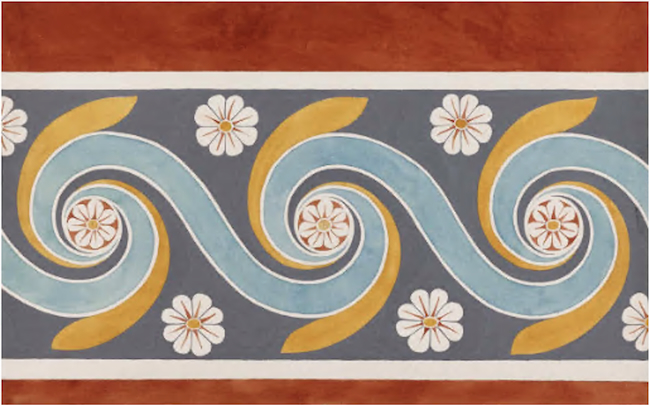
The British School at Athens celebrated its 50th anniversary in 1936 with a large public exhibition at Burlington House at the Royal Academy of Arts in London. The exhibition, British Archaeological Discoveries in Greece and Crete 1886-1936, consisted of a special display of Minoan culture related to the discoveries at Knossos by Sir Arthur Evans as well as the excavations of the School including: Phylakopi, Kamares Cave, Palaikastro, Mycenae, Sparta, Perachora, Thessaly, Macedonia, Lesbos, Cyprus, Ithaca, and Megalopolis (Arcadia). It also included displays of Travels and Studies in Greece and Asia Minor, the Genose in the Levant, Monasteries in Athos, Byzantine Music, Byzantine Architecture and Decorative Arts, Greek Island Embroideries, Special Studies of Greek Pottery and Sculpture, Restoration of Ancient Monuments, Studies of Modern Greek Life and the School buildings and officers.
Since original ancient artifacts could not be transported to the exhibition in London, the displays consisted of replicas of ancient artifacts, modern ethnographic artifacts and illustrative panels with original watercolour drawings, many of which were done by Émile Gilliéron and Piet de Jong, and photographs.
The 1936 Exhibition Collection contains the surviving panels with original artwork from this exhibition.
The original description in the catalogue reads: "Mosaic pavements from a Byzantine church at Theotokou in Thessaly."
The original description in the catalogue reads: "Mosaic pavements from a Byzantine church at Theotokou in Thessaly."
The original description in the catalogue reads: "Mosaic pavements from a Byzantine church at Theotokou in Thessaly."
The original description in the catalogue reads: "Mosaic pavements from a Byzantine church at Theotokou in Thessaly."
The original description in the catalogue reads: "Mosaic pavements from a Byzantine church at Theotokou in Thessaly."
The original description in the catalogue reads: "Mosaic pavements from a Byzantine church at Theotokou in Thessaly."
The original description in the catalogue reads: "Mosaic pavements from a Byzantine church at Theotokou in Thessaly."
The original description in the catalogue reads: "Mosaic pavements from a Byzantine church at Theotokou in Thessaly."
The original description in the catalogue reads: "Mosaic pavements from a Byzantine church at Theotokou in Thessaly."
The original description in the catalogue reads: "A Byzantine musical manuscript at the Monastery of Grottaferrata, near Rome: Codex Cyptensis, E.L. II, f. 38b."
The original description in the catalogue reads: "Transcription of the same page [item 351] (drawn by Miss G.R. Levy)."
The original description in the catalogue reads: "Geometric pitcher from Episkopi."
The original description in the catalogue reads: " Other geometric jars."
The original description in the catalogue reads: "Early orientalizing jug from Fortezza near Knossos."
The original description in the catalogue reads: " Other geometric jars."
The original description in the catalogue reads: " Other geometric jars."
The original description in the catalogue reads: " Other geometric jars."
The original description in the catalogue reads: "External decoration with fine pale glaze and polychrome."
The original description in the catalogue reads: "Internal decoration of lotus pattern in white and red on black."
The original description in the catalogue reads: "External decoration with fine pale glaze and polychrome."
The original description in the catalogue reads: "The horsemen have been painted on a black ground bearing a red pattern. But an ample margin of unpatterned black has been left round each figure to prevent the colours running or flaking. This vase also bears a local dedication."
The original description in the catalogue reads: "Statuette of a goddess, gaily painted, with genial archaic features: 600-500 B.C."
The original description in the catalogue reads: "Cook, grating cheese: his carving knife lies on a rest beside him: 600-500 B.C."
The original description in the catalogue reads: "Polychrome cup: a chieftain mounts to his seat beside the charioteer."
The original description in the catalogue reads: "Polychrome cup: a chieftain mounts to his seat beside the charioteer."
The original description in the catalogue reads: "Naukratite vase, of imported fabric (cf. 354 above): farmyard scene: about 550 B.C."
The original description in the catalogue reads: "Bottom of a Proto-Corinthian Pyxis, from the Argive Heraeum; left, as originally put together.".
The original description in the catalogue reads: "Bottom of a Proto-Corinthian Pyxis, from the Argive Heraeum… right, as reconstructed by Payne; water-colour by P. de Jong."
The original description in the catalogue reads: "Proto-Corinthian cup, at Ægina."
The original description in the catalogue reads: "Drawings of lions... From Attic vases (c. 600 B.C.)."
The original description in the catalogue reads: "Drawings of lions... From Attic vases (c. 600 B.C.)."
The original description in the catalogue reads: "Drawings of lions... From the Tomb of Menekrates at Corfu (c. 650 B.C)."
The original description in the catalogue reads: "Drawings of lions... From Corinthian vases."
The original description in the catalogue reads: "Drawings of lions"
The original description in the catalogue reads: "Drawings of lions... From Corinthian vases."
The original description in the catalogue reads: "Drawings of lions... Plastic vases in the form of lions."
The original description in the catalogue reads: "Drawings of lions... Stone lion from Nineveh."
The original description in the catalogue reads: "Drawings of lions... Plastic vases in the form of lions."
The original description in the catalogue reads: "Drawings of lions... Plastic vases in the form of lions."
The original description in the catalogue reads: "Drawings of figures and ornaments on proto-Corinthian and Corinthian vases."
The original description in the catalogue reads: "Drawings of figures and ornaments on proto-Corinthian and Corinthian vases."
The original description in the catalogue reads: "Drawings of figures and ornaments on proto-Corinthian and Corinthian vases."
The original description in the catalogue reads: "Drawings of figures and ornaments on proto-Corinthian and Corinthian vases."
The original description in the catalogue reads: "Drawings of figures and ornaments on proto-Corinthian and Corinthian vases."
The original description in the catalogue reads: "Drawings of figures and ornaments on proto-Corinthian and Corinthian vases."
The original description in the catalogue reads: "Drawings of figures and ornaments on proto-Corinthian and Corinthian vases."
The original description in the catalogue reads: "Drawings of figures and ornaments on proto-Corinthian and Corinthian vases."
The original description in the catalogue reads: "Athena Ergané (a): seated figure, spinning. Drawing and photograph."
The original description in the catalogue reads: "Heracles wrestling with the Nemean Lion."
The original description in the catalogue reads: "Athena Promachos mounting her war-chariot. Drawing and photograph."