

About the 1936 Exhibition Collection
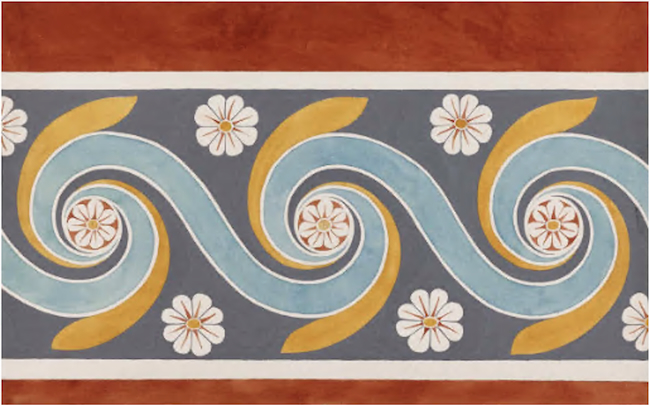
The British School at Athens celebrated its 50th anniversary in 1936 with a large public exhibition at Burlington House at the Royal Academy of Arts in London. The exhibition, British Archaeological Discoveries in Greece and Crete 1886-1936, consisted of a special display of Minoan culture related to the discoveries at Knossos by Sir Arthur Evans as well as the excavations of the School including: Phylakopi, Kamares Cave, Palaikastro, Mycenae, Sparta, Perachora, Thessaly, Macedonia, Lesbos, Cyprus, Ithaca, and Megalopolis (Arcadia). It also included displays of Travels and Studies in Greece and Asia Minor, the Genose in the Levant, Monasteries in Athos, Byzantine Music, Byzantine Architecture and Decorative Arts, Greek Island Embroideries, Special Studies of Greek Pottery and Sculpture, Restoration of Ancient Monuments, Studies of Modern Greek Life and the School buildings and officers.
Since original ancient artifacts could not be transported to the exhibition in London, the displays consisted of replicas of ancient artifacts, modern ethnographic artifacts and illustrative panels with original watercolour drawings, many of which were done by Émile Gilliéron and Piet de Jong, and photographs.
The 1936 Exhibition Collection contains the surviving panels with original artwork from this exhibition.
An illustration of a lidded box. There are two panels of decoration; the left shows a fish and some stars, the right shows a bird. The original description in the catalogue reads: "Painted Larnax (clay coffin) found in the bank of the Palaikastro River: the style suggests an early date in Late Minoan III."
An illustration of a figurine with two places where the arms would be sticking out, one on either side. The same item as 1936/01/03/21/06 (d) from a different angle. The original description in the catalogue reads: "Figurine, from the Town: two views."
An illustration of the body of a male figurine, in red with an off-white loincloth and boots, with a brown item at the waist. The hands are held up to the chest. The original description in the catalogue reads: "Male figure from the same deposit at Petsofà."
An illustration of a figurine with one places where the arm would be sticking out at the front of this angle. The same item as 1936/01/03/21/04 (c) from a different angle. The original description in the catalogue reads: "Figurine, from the Town: two views."
An illustration of the back of a male statuette with long hair from the chest up; the right arm appears to be raised but only the shoulder remains. This is the same statuette as in 1936/01/03/22/02 and 03 from a different angle. The original description in the catalogue reads: "Male statuette of Late Minoan date, with long hair: three views of the same."
An illustration of the front of a male statuette with long hair from the chest up; the right arm appears to be raised but only the shoulder remains. This is the same statuette as in 1936/01/03/22/01 and 03 from a different angle. The original description in the catalogue reads: "Male statuette of Late Minoan date, with long hair: three views of the same."
An illustration of the left side of a male statuette with long hair from the chest up. This is the same statuette as in 1936/01/03/22/01 and 02 from a different angle. The original description in the catalogue reads: "Male statuette of Late Minoan date, with long hair: three views of the same."
An illustration of lampstand, with repeating decoration around the rim and centre. Erased writing underneath the illustration says "Half full size". The original description in the catalogue reads: "Tall lampstand of stone (c): these tall lamps and stands are of the form common in L.M. III."
An illustration of a statuette of a woman in a skirt, from the front. This is the same statuette as in 1936/01/03/22/06 from a different angle. The original description in the catalogue reads: "Statuettes of women. Compare the clay figure 99d."
An illustration of a statuette of a woman in a skirt, from a 3/4 view of the back. This is the same statuette as in 1936/01/03/22/05 from a different angle. The original description in the catalogue reads: "Statuettes of women. Compare the clay figure 99d."
An illustration of a pin with a bend around a third of the way from the bottom. On the head of the pin is a seated dog; the ears have been imagined using dotted lines. The original description in the catalogue reads: " Pin, with a dog forming the head: brought to the excavators by a workman."
An illustration of a statuette of a woman, from the front. The statuette is missing arms and legs, and is naked, but something is carved over the groin area. This is the same statuette as in 1936/01/03/22/09 from a different angle. The original description in the catalogue reads: "Statuettes of women. Compare the clay figure 99d."
An illustration of a statuette of a woman, from the front. The statuette is missing arms and legs, and is naked, but something is carved over the groin area. This is the same statuette as in 1936/01/03/22/08 from a different angle. The original description in the catalogue reads: "Statuettes of women. Compare the clay figure 99d."
An illustration of a bowl with two handles. The rim and handles have a ribbed pattern. The original description in the catalogue reads: "Steatite bowl of L.M. II date, from a hoard of thirty-six vessels found together in one of the houses."
An illustration of a statuette of an amorphous woman, from the front. This is the same statuette as in 1936/01/03/22/12 from a different angle. The original description in the catalogue reads: "Statuettes of women. Compare the clay figure 99d."
An illustration of a statuette of an amorphous woman, from the front. This is the same statuette as in 1936/01/03/22/11 from a different angle. The original description in the catalogue reads: "Statuettes of women. Compare the clay figure 99d."
Watercolour illustration of a decorated shield. Sections that do not survive are outlined but not painted. The original description in the catalogue reads: "Bronze shield from the temple of Dictaean Zeus. This (a) is the only well-preserved example."
An illustration in blue of part of a shield, showing three and a half deer grazing. Some unpainted sections have been filled in from the surviving sections. The original description in the catalogue reads: "Besides the large shield, three others were found, more or less fragmentary, decorated with narrow zones of animals between bands of guilloche ornament."
An illustration in blue of part of a shield, showing two and a half spotted animals. Some unpainted sections have been filled in from the surviving sections. The original description in the catalogue reads: "Besides the large shield, three others were found, more or less fragmentary, decorated with narrow zones of animals between bands of guilloche ornament."
An illustration in blue of part of a shield, with two bands of decoration The inner band shows five sitting deer and another animal. The outer band shows five grazing animals and the bust of a woman. Some unpainted sections have been filled in from the surviving sections. The original description in the catalogue reads: "Besides the large shield, three others were found, more or less fragmentary, decorated with narrow zones of animals between bands of guilloche ornament."
An ink plan entitled "Sanctuary of Artemis Orthia Sparta 1910" in the upper right corner, drawn at a scale of 1:400. The plan shows both excavated and excavated sections, with the Eurotas River at the top of the plan. The original description in the catalogue reads: "General plan of the Orthia sanctuary as revealed by the excavation: note the series of altars, temples and enclosure walls."
An ink sectional drawing showing the archaeological layers from Sparta. The majority is on a single piece of paper, but each ends is on its own separate sheet. There is some erased writing in the lower left corner, and an 'X' in the lower centre. The original description in the catalogue reads: "Sectional drawings of the Orthia sanctuary, showing the whole series of deposits, from the earliest debris of offerings, going back to the 10th century B.C. to the Theatre and Altar of the Roman period, which may be dated to the middle of the 3rd century A.D. The Roman theatre, until recent years a conspicuous monument, has been almost entirely destroyed, but from the traces left on the upper surface of its foundation, its dimensions have been recovered."
An ink sectional drawing showing the archaeological layers at Sparta, at a scale of 1:100. There is an 'X' in the upper centre edge with a line going up t wards the' X' on the other drawing. The original description in the catalogue reads: "Sectional drawings of the Orthia sanctuary, showing the whole series of deposits, from the earliest debris of offerings, going back to the 10th century B.C. to the Theatre and Altar of the Roman period, which may be dated to the middle of the 3rd century A.D. The Roman theatre, until recent years a conspicuous monument, has been almost entirely destroyed, but from the traces left on the upper surface of its foundation, its dimensions have been recovered."
An ink plan showing the west elevation (top) and plan of the Menelaion at Sparta, at a 1:200 scale. The original description in the catalogue reads: "Plan of the Menelaion Sanctuary beyond the River Eurotas. Here a traditional worship of Menelaos and Helen persisted from the latest Minoan times, before the reputed date of the Dorian occupation of Laconia."
An ink plan showing a theatre titled "Sparta General Plan (Revised 1924-1928)". It is comprised of part of a grid, boxes J-L horizontally and 11-13 vertically. There is a scale bar at the bottom The original description in the catalogue reads: "Plan of the theatre on the Acropolis of Sparta."
A black and white photograph of a field with trees in the foreground, and two rows of mountains behind. The original description in the catalogue reads: "Mount Taygetos, from near Sparta: photograph by the late Shirley C. Atchley."
A black and white photograph of nine men; five standing at the back, three sitting on chairs, and one sitting on the floor in front of them.
A black and white photograph of an archaeological trench, with three workmen digging in it and one standing behind them with a shovel. In the background is another trench with two workmen digging and one standing behind with a measuring stick. The photograph has been attached to a board which is then attached to the base. The original description in the catalogue reads: "Photographs of the Spartan Excavations in progress: Digging out the small votive offerings at the Orthia Sanctuary."
A black and white photograph with a body of water on the right with a woman leaning over in it. On the banks are seven women sitting around buckets, four in the foreground and three in the background, and a woman and a man standing. The photograph has been attached to a board which is then attached to the base. The original description in the catalogue reads: "Photographs of the Spartan Excavations in progress: Washing the earth from round the Altar of Orthia in sieves to recover small objects and broken fragments."
A black and white photograph of two men digging by the wall of in archaeological trench. The photograph has been attached to a board which is then attached to the base. The original description in the catalogue reads: "Photographs of the Spartan Excavations in progress: Recovering small objects at the Orthia Sanctuary."
Plate with three precisely cut out photographs, of a relief of a man, labelled 16, a relief of a horse, labelled 17, and another small animal, labelled 19. The original description in the catalogue reads: "Relief of a man; a fragment of a horse, to be cut out à jour; and a small animal."
Plate with six precisely cut out photographs of reliefs. The top two each show two lions facing each other, labelled 41 and 42, while the remainder show fragments of single lion labelled 43-47, clockwise from left. The original description in the catalogue reads: "Reliefs of lions. The two upper plaques, each with a pair of confronted lions, are likely to preserve the subject of a relief occupying the pediment of the Later Temple, of which 153 is an actual fragment."
Plate with five precisely cut out photographs of reliefs, showing horses or fragments of horses facing left. The one in the centre is larger, labelled 24, while the rest are labelled 23, 25, 26, and 27. The original description in the catalogue reads: "Reliefs of horses."
A watercolour illustration of a shield, decorated with curved lines from the centre to the edge in white, black, and red, with a red centre and a black rim with white spots with red spots in the centre. Some sections are painted paler, indicating that they are reconstructed.
A watercolour illustration of the back of a shield, painted red with half with a red and white scales pattern. A handle can be seen. Below is a line drawing showing the shield in profile to indicate its shape and the shape of the handle.
Four ink drawings of figures. Those on the right and left are the same figure from different angles, of a figure carrying a lamb or similar animal over its shoulders. The upper and lower images have been pasted.
A watercolour illustration showing part of the mane of a stone lion. The mane section is largely painted yellow,with some parts blue and red. The original description in the catalogue reads: "Fragment of the mane of a lion in poros limestone, gaily coloured: probably from the pediment of the Later Temple, which may have been decorated by a group of two lions arranged as on the limestone reliefs, 152b."
A black and white photograph showing a sherd. At the bottom is a relief of a horse drawn chariot with two men in armour. Above is a battle scene, of which we can see two men fighting and one lying on the ground. The original description in the catalogue reads: "Fragment of a large clay jar (pithos) with moulded reliefs: on the neck a combat of armed warriors and on the body a chariot: found at the small Heröon on the bank of the Eurotas a little upstream from the Orthia sanctuary."
An ink illustration of a plaque showing two people facing each other holding two circular objects between them. Some sections, shown by dotted lines, are recreated and not part of the surviving object. The original description in the catalogue reads: "Ivory plaques (a-f), for the most part affixed to the front of bronze brooches (fibulae). They belong to the years about 700 B.C.: (a) is rather earlier than the rest; (f) rather later."
An ink illustration of a plaque showing two people facing each other, one holding a circular object between them and the other holding their wrist. Some sections, shown by dotted lines, are recreated and not part of the surviving object. The original description in the catalogue reads: "Ivory plaques (a-f), for the most part affixed to the front of bronze brooches (fibulae). They belong to the years about 700 B.C.: (a) is rather earlier than the rest; (f) rather later."
An ink illustration of a plaque showing a female figure facing forward. To the right is a profile view of the object, showing is from the side. The original description in the catalogue reads: "Ivory plaques (a-f), for the most part affixed to the front of bronze brooches (fibulae). They belong to the years about 700 B.C.: (a) is rather earlier than the rest; (f) rather later."
An ink illustration of a plaque showing three people holding hands, Some sections, shown by dotted lines, are recreated and not part of the surviving object. The original description in the catalogue reads: "Ivory plaques (a-f), for the most part affixed to the front of bronze brooches (fibulae). They belong to the years about 700 B.C.: (a) is rather earlier than the rest; (f) rather later."
An ink illustration of a plaque showing a man leaning back on his knees with a large bird attacking his chest. Some sections, shown by dotted lines, are recreated and not part of the surviving object. The original description in the catalogue reads: "Ivory plaques (a-f), for the most part affixed to the front of bronze brooches (fibulae). They belong to the years about 700 B.C.: (a) is rather earlier than the rest; (f) rather later."
An ink illustration of a plaque showing three people standing behind a coffin. Some sections, shown by dotted lines, are recreated and not part of the surviving object. The original description in the catalogue reads: "Ivory plaques (a-f), for the most part affixed to the front of bronze brooches (fibulae). They belong to the years about 700 B.C.: (a) is rather earlier than the rest; (f) rather later."
An ink illustration of a lion with one paw over a calf and the calf's rear in its mouth. It is the same objects as 1936/01/05/16/08 from a different angle. The original description in the catalogue reads: "Ivory lion holding a calf; before 600 B.C. Several such figures were found: compare the man stabbing the lioness (160b) and the couchant animals (160f); but these figures are much larger and of rather later date."
An ink illustration of a lion lying down with the rear of an animal in its mouth, shown from behind. It is the same objects as 1936/01/05/16/07 from a different angle. Some sections, shown by dotted lines, are recreated and not part of the surviving object. The original description in the catalogue reads: "Ivory lion holding a calf; before 600 B.C. Several such figures were found: compare the man stabbing the lioness (160b) and the couchant animals (160f); but these figures are much larger and of rather later date."
An ink illustration of a semicircular plaque. The centre shows a ship with men with shields. It has a name written on the side. Below the ship are three fish, and around the lower curved edge is a repeating pattern on circles. Some sections, shown by dotted lines, are recreated and not part of the surviving object. The original description in the catalogue reads: "Ivory plaque with a relief of a ship (a) and dedication to "Orthaia": the edge was inset with amber bosses: before 600 B.C."
An ink illustration of a rectangular plaque, depicting a man with a spear rising a tall horse. Another man with a shield appears to be sitting on the horse's back. Some sections, shown by dotted lines, are recreated and not part of the surviving object. The original description in the catalogue reads: "Ivory plaques: 700-600 B.C."
An ink illustration of a rectangular plaque, depicting the slaying of the gorgon. The winged, snake-haired gorgon is kneeling on the right, and a man on the left is stabbing her with a sword, with one foot on her lower legs. Some sections, shown by sections that are only outlined and not shaded, are recreated and not part of the surviving object. The original description in the catalogue reads: "Ivory plaques: 700-600 B.C."
An ink illustration of two semi-circles, with the lower flat edges having the top teeth of a comb visible. The upper semicircle contains a boar, the lower has an unidentified animal. Some sections, shown by dotted lines, are recreated and not part of the surviving object. The original description in the catalogue reads: "Ivory comb: compare originals in Case B."