

About the 1936 Exhibition Collection
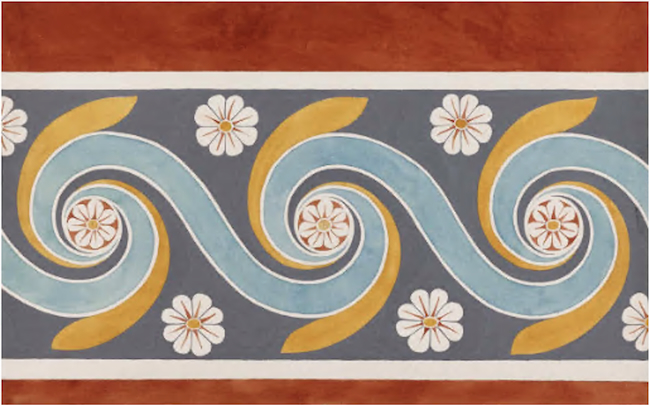
The British School at Athens celebrated its 50th anniversary in 1936 with a large public exhibition at Burlington House at the Royal Academy of Arts in London. The exhibition, British Archaeological Discoveries in Greece and Crete 1886-1936, consisted of a special display of Minoan culture related to the discoveries at Knossos by Sir Arthur Evans as well as the excavations of the School including: Phylakopi, Kamares Cave, Palaikastro, Mycenae, Sparta, Perachora, Thessaly, Macedonia, Lesbos, Cyprus, Ithaca, and Megalopolis (Arcadia). It also included displays of Travels and Studies in Greece and Asia Minor, the Genose in the Levant, Monasteries in Athos, Byzantine Music, Byzantine Architecture and Decorative Arts, Greek Island Embroideries, Special Studies of Greek Pottery and Sculpture, Restoration of Ancient Monuments, Studies of Modern Greek Life and the School buildings and officers.
Since original ancient artifacts could not be transported to the exhibition in London, the displays consisted of replicas of ancient artifacts, modern ethnographic artifacts and illustrative panels with original watercolour drawings, many of which were done by Émile Gilliéron and Piet de Jong, and photographs.
The 1936 Exhibition Collection contains the surviving panels with original artwork from this exhibition.
The original description in the catalogue reads: "Painted pottery, red on white, of the First Neolithic Age, from Zerélia."
The original description in the catalogue reads: "Painted vase, (a) black on red, of the Second Neolithic age, from Rakhmáni near Tempe."
The original description in the catalogue reads: "Red on white, of the First Neolithic Age, from Thessalian Sites."
The original description in the catalogue reads: "Red on white, of the First Neolithic Age, from Thessalian Sites."
The original description in the catalogue reads: "Red on white, of the First Neolithic Age, from Thessalian Sites."
The original description in the catalogue reads: "Red on white, of the First Neolithic Age, from Thessalian Sites."
The original description in the catalogue reads: "A stone pestle and mortar": catalogue incorrectly states that this is b when it is a.
The original description in the catalogue reads: "Terracotta statuettes of the Bronze Age from various sites in Thessaly."
The original description in the catalogue reads: "Terracotta statuettes of the Bronze Age from various sites in Thessaly."
The original description in the catalogue reads: "Terracotta statuettes of the Bronze Age from various sites in Thessaly. Statuettes of local type, with terracotta bodies and heads of painted stone."
The original description in the catalogue reads: "Terracotta statuettes of the Bronze Age from various sites in Thessaly. Statuettes of local type, with terracotta bodies and heads of painted stone."
The original description in the catalogue reads: "Terracotta statuettes of the Bronze Age from various sites in Thessaly. Statuettes of local type, with terracotta bodies and heads of painted stone."
The original description in the catalogue reads: "Terracotta statuettes of the Bronze Age from various sites in Thessaly."
The original description in the catalogue reads: "Map of the fifth settlement: of Early Bronze Age, about 2400-2300 B.C., showing fortifications and house-foundations: the red disc shows the point from which the panorama 314d was taken."
The original description in the catalogue reads: " A House-Hearth (Thermi V); with stone foundation covered with potsherds: beyond is an ash-dump."
The original description in the catalogue reads: "Fortifications of the Fifth Settlement: the wide inner masonry is supplemented with outer walls."
The original description in the catalogue reads: "Watch-tower by the north-western gate of the Fifth Settlement."
Made up of three photographs but printed on a single piece of paper. The original description in the catalogue reads: "Panorama of the Fifth Settlement, showing the southern streets and houses: the circular erections are house-hearths."
The original description in the catalogue reads: "Bronze birds; from the First Settlement: about 3700-2800 B.C."
The original description in the catalogue reads: "Grey pottery from Antissa, developed from wares like the 'Minyan' fabric of the Late Bronze Age."
The original description in the catalogue reads: "Grey pottery from Antissa, developed from wares like the 'Minyan' fabric of the Late Bronze Age."
The original description in the catalogue reads: "Bronze birds; from the First Settlement: about 3700-2800 B.C."
The original description in the catalogue reads: "The Apsidal Temples, superposed. The earlier (c. 1000-800 B.C.) had the apse at the east end. The later (c. 800-600 B.C.), on the same foundations, had the apse to the west, so that the combined plan appears oval."
The original description in the catalogue reads: "The Apsidal Temples, superposed. The earlier (c. 1000-800 B.C.) had the apse at the east end. The later (c. 800-600 B.C.), on the same foundations, had the apse to the west, so that the combined plan appears oval."
The original description in the catalogue reads: "Late Minoan I vase (c. 1500 B.C.)."
The original description in the catalogue reads: "View of the excavation (a), with the peak of Mt. Dikte in the distance."
The original description in the catalogue reads: "Plan of the Late Minoan house."
The original description in the catalogue reads: "Anthropomorphic vase."
The original description in the catalogue reads: " Ivory seal in the shape of a seated monkey: probably Early Minoan II."
The original description in the catalogue reads: "Terracotta figure seated in chair."
The original description in the catalogue reads: "Ivory head with inlaid eyes: probably Early Minoan II."
The original description in the catalogue reads: "Ivory head with inlaid eyes: probably Early Minoan II."
The original description in the catalogue reads: "Ivory head with inlaid eyes: probably Early Minoan II."
The original description in the catalogue reads: "Inscribed base of a libation vase: Middle Minoan I."
The original description in the catalogue reads: "Ivory figurines, including a new type with split aprons: Early Minoan II."
The original description in the catalogue reads: "Ivory figurines, including a new type with split aprons: Early Minoan II."
The original description in the catalogue reads: "Ivory figurines, including a new type with split aprons: Early Minoan II."
The original description in the catalogue reads: "Stone vases: Early Minoan II and III."
The original description in the catalogue reads: "Vase of the new 'Trapeza Ware,' with modelled face."
The original description in the catalogue reads: "Larnax (clay burial-chest) with spirited ornament of running spirals in dark red on a buff ground."
The original description in the catalogue reads: "Small amphora: the pairs of double handles are unusual in a vase only 12 inches high."
The original description in the catalogue reads: "Geometric pottery. c, d. Jug and bowl from a 'beehive' tomb: (c) is a good instance of the rich effect simply produced in geometric art."
The original description in the catalogue reads: "Geometric pottery. c, d. Jug and bowl from a 'beehive' tomb."
The original description in the catalogue reads: "Geometric pottery."
The original description in the catalogue reads: "Geometric pottery… Probably an imitation of an Attic 'Dipylon' Vase."
The original description in the catalogue reads: "Geometric pottery...The rayed circles on the neck of the miniature amphora are unusual."
The original description in the catalogue reads: "Minoan gem, found adhering to the mortar of a Hellenistic bathroom. A bull lying in a forest is surprised by a hunter who seizes both its horns. The bull is admirably modelled in the grand Minoan style: by contrast the human figure seems a mere appendage. Drawn by M. Gillièron."
The original description in the catalogue reads: "A male head, heroic or divine, modelled, not cast: it may be as late as the first part of the fifth century. The projection of the chin and its deep depression are unusual. The ears are conventional and, like the falling locks, reminiscent of wood carving."
The original description in the catalogue reads: "Female figure (priestess?)."
The original description in the catalogue reads: "Lion, drawing: perhaps as early as the sixth century."