

About the 1936 Exhibition Collection
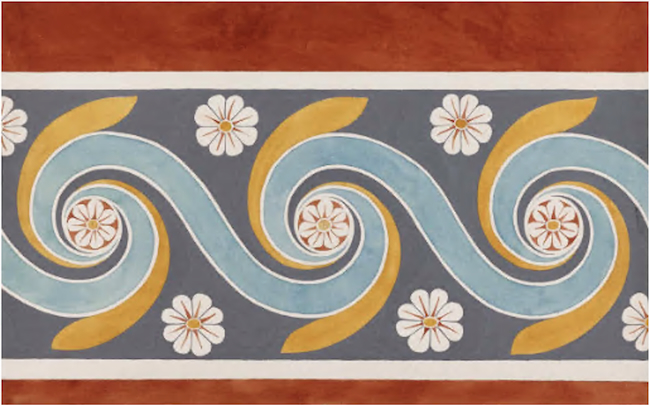
The British School at Athens celebrated its 50th anniversary in 1936 with a large public exhibition at Burlington House at the Royal Academy of Arts in London. The exhibition, British Archaeological Discoveries in Greece and Crete 1886-1936, consisted of a special display of Minoan culture related to the discoveries at Knossos by Sir Arthur Evans as well as the excavations of the School including: Phylakopi, Kamares Cave, Palaikastro, Mycenae, Sparta, Perachora, Thessaly, Macedonia, Lesbos, Cyprus, Ithaca, and Megalopolis (Arcadia). It also included displays of Travels and Studies in Greece and Asia Minor, the Genose in the Levant, Monasteries in Athos, Byzantine Music, Byzantine Architecture and Decorative Arts, Greek Island Embroideries, Special Studies of Greek Pottery and Sculpture, Restoration of Ancient Monuments, Studies of Modern Greek Life and the School buildings and officers.
Since original ancient artifacts could not be transported to the exhibition in London, the displays consisted of replicas of ancient artifacts, modern ethnographic artifacts and illustrative panels with original watercolour drawings, many of which were done by Émile Gilliéron and Piet de Jong, and photographs.
The 1936 Exhibition Collection contains the surviving panels with original artwork from this exhibition.
The original description in the catalogue reads: "Architectural Terracottas from various buildings at the Orthia Sanctuary."
The original description in the catalogue reads: "Architectural Terracottas from various buildings at the Orthia Sanctuary."
The original description in the catalogue reads: "Architectural Terracottas from various buildings at the Orthia Sanctuary."
The original description in the catalogue reads: "Architectural Terracottas from various buildings at the Orthia Sanctuary."
The original description in the catalogue reads: "Architectural Terracottas from various buildings at the Orthia Sanctuary."
The original description in the catalogue reads: "Architectural Terracottas from various buildings at the Orthia Sanctuary."
The original description in the catalogue reads: "Architectural Terracottas from various buildings at the Orthia Sanctuary."
The original description in the catalogue reads: "Architectural Terracottas from various buildings at the Orthia Sanctuary."
The original description in the catalogue reads: "Laconian Geometric and Sub-Geometric Pottery."
The original description in the catalogue reads: "Laconian Geometric and Sub-Geometric Pottery."
The original description in the catalogue reads: "Laconian Geometric and Sub-Geometric Pottery."
The original description in the catalogue reads: "Laconian Geometric and Sub-Geometric Pottery."
The original description in the catalogue reads: "Laconian Geometric and Sub-Geometric Pottery."
The original description in the catalogue reads: " Jug of Laconian III Style; frieze of birds, sphinxes and lions."
The original description in the catalogue reads: "Drinking Cup of Laconian III style: restored drawing."
The original description in the catalogue reads: " Jar (lakaina, a typically Spartan vessel) of Laconian II style: note the handles made of running Gorgons. It was found in minute fragments very widely scattered."
The original description in the catalogue reads: "Painted interior of a Laconian III kylix; four men, a palm--tree, and a monkey."
The original description in the catalogue reads: "Vases and fragments of Laconian III style."
The original description in the catalogue reads: "Vases and fragments of Laconian III style: a. A procession."
The original description in the catalogue reads: "Vases and fragments of Laconian III style."
The original description in the catalogue reads: "Vases and fragments of Laconian III style."
The original description in the catalogue reads: "Vases and fragments of Laconian III style."
The original description in the catalogue reads: "Vases and fragments of Laconian III style: b. Interior of a kylix: Cocks feeding."
The original description in the catalogue reads: "Vases and fragments of Laconian III style: c. Exterior of the same: Dionysiac revel."
The original description in the catalogue reads: "Panathenaic Amphora, found on the site of the Temple of Athena Chalkioikos: these vases, of Attic fabric, were made and widely distributed in connexion with the Panathenaic Festivals at Athens; they usually have an archaic figure of Athena on one side and an athletic contest on the other."
The original description in the catalogue reads: "Panathenaic Amphora, found on the site of the Temple of Athena Chalkioikos: these vases, of Attic fabric, were made and widely distributed in connexion with the Panathenaic Festivals at Athens; they usually have an archaic figure of Athena on one side and an athletic contest on the other."
The original description in the catalogue reads: "Vase imitating attic red-figured technique: procession of trumpeters and horsemen. The figure are not 'reversed' in the red surface of the clay, but painted in red over the black glaze."
The original description in the catalogue reads: "Figures of warriors: Note the plaque resembling the ivory plaques for fibulae."
The original description in the catalogue reads: "Figures of warriors: Note the plaque resembling the ivory plaques for fibulae."
The original description in the catalogue reads: "Figures of warriors: Note the plaque resembling the ivory plaques for fibulae."
The original description in the catalogue reads: "Figures of warriors: Note the plaque resembling the ivory plaques for fibulae."
The original description in the catalogue reads: "Figures of warriors: Note the plaque resembling the ivory plaques for fibulae."
The original description in the catalogue reads: "Figures of warriors: Note the plaque resembling the ivory plaques for fibulae."
The original description in the catalogue reads: "Figures of warriors: Note the plaque resembling the ivory plaques for fibulae."
The original description in the catalogue reads: "Figures of warriors: Note the plaque resembling the ivory plaques for fibulae."
The original description in the catalogue reads: "Figures of warriors: Note the plaque resembling the ivory plaques for fibulae."
The original description in the catalogue reads: "Figures of warriors: Note the plaque resembling the ivory plaques for fibulae."
The original description in the catalogue reads: "The Orthia goddess with attendants; she holds a pair of lions by their tails."
The original description in the catalogue reads: "The Orthia goddess with attendants; she holds a pair of lions by their tails."
The original description in the catalogue reads: "The Orthia goddess with attendants; she holds a pair of lions by their tails."
The original description in the catalogue reads: "The Orthia goddess with attendants; she holds a pair of lions by their tails."
The original description in the catalogue reads: "The Orthia goddess with attendants; she holds a pair of lions by their tails."
The original description in the catalogue reads: "The Orthia goddess with attendants; she holds a pair of lions by their tails."
The original description in the catalogue reads: "The Orthia goddess with attendants; she holds a pair of lions by their tails."
The original description in the catalogue reads: "The Orthia goddess with attendants; she holds a pair of lions by their tails."
The original description in the catalogue reads: "The Orthia goddess with attendants; she holds a pair of lions by their tails."
The original description in the catalogue reads: "The Orthia goddess with attendants; she holds a pair of lions by their tails."
The original description in the catalogue reads: "The Orthia goddess with attendants; she holds a pair of lions by their tails."
The original description in the catalogue reads: "The Orthia goddess with attendants; she holds a pair of lions by their tails."
The original description in the catalogue reads: "The Orthia goddess with attendants; she holds a pair of lions by their tails."