

About the 1936 Exhibition Collection
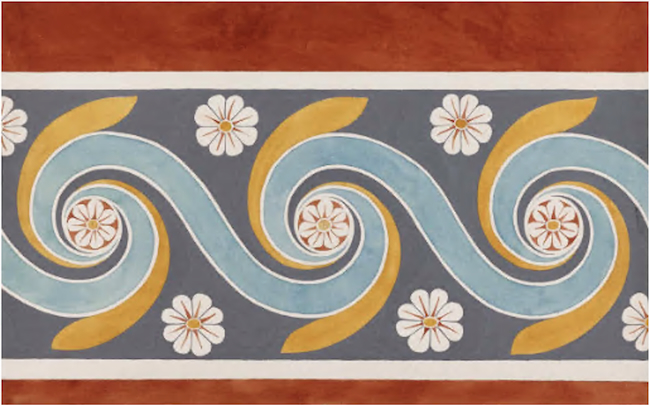
The British School at Athens celebrated its 50th anniversary in 1936 with a large public exhibition at Burlington House at the Royal Academy of Arts in London. The exhibition, British Archaeological Discoveries in Greece and Crete 1886-1936, consisted of a special display of Minoan culture related to the discoveries at Knossos by Sir Arthur Evans as well as the excavations of the School including: Phylakopi, Kamares Cave, Palaikastro, Mycenae, Sparta, Perachora, Thessaly, Macedonia, Lesbos, Cyprus, Ithaca, and Megalopolis (Arcadia). It also included displays of Travels and Studies in Greece and Asia Minor, the Genose in the Levant, Monasteries in Athos, Byzantine Music, Byzantine Architecture and Decorative Arts, Greek Island Embroideries, Special Studies of Greek Pottery and Sculpture, Restoration of Ancient Monuments, Studies of Modern Greek Life and the School buildings and officers.
Since original ancient artifacts could not be transported to the exhibition in London, the displays consisted of replicas of ancient artifacts, modern ethnographic artifacts and illustrative panels with original watercolour drawings, many of which were done by Émile Gilliéron and Piet de Jong, and photographs.
The 1936 Exhibition Collection contains the surviving panels with original artwork from this exhibition.
The original description in the catalogue reads: "Pendants and ornaments: note the Double Axe, surviving as an amulet from Minoan times."
The original description in the catalogue reads: "Pendants and ornaments: note the Double Axe, surviving as an amulet from Minoan times."
The original description in the catalogue reads: "Pendants and ornaments: note the Double Axe, surviving as an amulet from Minoan times."
The original description in the catalogue reads: "Pendants and ornaments: note the Double Axe, surviving as an amulet from Minoan times."
The original description in the catalogue reads: "Pendants and ornaments: note the Double Axe, surviving as an amulet from Minoan times."
The original description in the catalogue reads: "Pendants and ornaments: note the Double Axe, surviving as an amulet from Minoan times."
The original description in the catalogue reads: "Pendants and ornaments: note the Double Axe, surviving as an amulet from Minoan times."
The original description in the catalogue reads: "Pendants and ornaments: note the Double Axe, surviving as an amulet from Minoan times."
The original description in the catalogue reads: "Pendants and ornaments: note the Double Axe, surviving as an amulet from Minoan times."
The original description in the catalogue reads: "Pendants and ornaments: note the Double Axe, surviving as an amulet from Minoan times."
The original description in the catalogue reads: "Pendants and ornaments: note the Double Axe, surviving as an amulet from Minoan times."
A black and white photograph looking down into a circular cistern with water at the bottom. The original description in the catalogue reads: "Hellenistic Cistern."
A black and white print of an isometric drawing of a building, with a scale bar and compass at the bottom. Some pencil annotations from the original image are visible, including a title: "Perachora 1932 Isometric View of Temple of Hera". In the lower right corner is written "Piet de Jong". A small amount of the original card base is visible at certain points along the edges. On the lower left corner of the image is written in pencil 205, and then lighter, a. The original description in the catalogue reads: "The third temple of Hera Akraia, isometric drawing."
A black and white print titled 'Perachora Longitudinal section through site'. A pencil drawing from the original image is visible at the top of the print. At the bottom is a scale bar and cardinal directions and arrows pointing west (left) and east (right). In the lower left is written "1929" and the lower right "1932". A small amount of the original card base is visible at certain points along the edges, and on part of this below the image is the pasted letter b, with 205 written in pencil to the left. The original description in the catalogue reads: "Longitudinal section through the site. Left to right: lighthouse rocks, market place, temple of Hera Akraia, portico, cistern, Roman house walls, temple of Hera Limenia."
A black and white print titled 'Longitudinal section', showing an underground cistern. There is a key to the left and a compass beneath, then a plan from above, and a scale in metres at the bottom. 205 c is written in pencil in the lower left. The original description in the catalogue reads: "Section of the great cistern."
Card base with black and white photograph taken from the bottom of a set of steps photograph attached. The letter a is pasted in the centre of the lower edge. The original description in the catalogue reads: "Steps leading down to a cistern."
Card base with one black and white photograph showing the corner of an excavated site, with a complete building in the background. attached. The letter b is pasted in the centre of the lower edge of the base. The original description in the catalogue reads: "Portico, with the chapel of St. John, built over the first (Geometric) temple of Hera Akraia. The chapel has since been removed and rebuilt on another site."
Card base with one black and white photograph with a rock with an inscription on it at the bottom. A person is holding up something white to block out the back ground: their hands and neck can be seen at the top of the image. The letter c is pasted in the centre of the lower edge of the base. The original description in the catalogue reads: "Seventh-century inscription on one of the sides of the altar (212c), 'I am a drachma for Hera of the White Arms.' This stone originally supported an offering, perhaps a drachma or handful of iron spits (which were the earliest coinage) like those dedicated at the Argive Heraeum, and the Orthia Sanctuary (195)."
The original description in the catalogue reads: "Wall surrounding the sanctuary of Hera Limenia."
The original description in the catalogue reads: "Hellenistic drain: the cistern (204) is at the lower end."
The original description in the catalogue reads: "Altar inside the temple of Hera Limenia (7th century). Three sides are formed of inscribed stones which had already been used to support dedications (cf. 209c)."
The original description in the catalogue reads: "Altar of the third temple of Hera Akraia: the triglyphs are very rarely set thus on ground level. In front, a column of the fourth-century portico."
The original description in the catalogue reads: "Geometric bowl (750-700 B.C.). The spindly birds in panels are typical of this period."
The original description in the catalogue reads: "Protocorinthian sherd: sphinx and birds."
The original description in the catalogue reads: "Protocorinthian pottery (725-650 B.C.). The animals, especially lions, birds, and fabulous monsters, are typical. The human figure and horseman are rarer. Note the hare-hunt (top row, second from left)."
The original description in the catalogue reads: "Protocorinthian pottery (725-650 B.C.). The animals, especially lions, birds, and fabulous monsters, are typical. The human figure and horseman are rarer. Note the hare-hunt (top row, second from left)."
The original description in the catalogue reads: "Protocorinthian pottery (725-650 B.C.). The animals, especially lions, birds, and fabulous monsters, are typical. The human figure and horseman are rarer. Note the hare-hunt (top row, second from left)."
The original description in the catalogue reads: "Protocorinthian pottery (725-650 B.C.). The animals, especially lions, birds, and fabulous monsters, are typical. The human figure and horseman are rarer. Note the hare-hunt (top row, second from left)."
The original description in the catalogue reads: "Protocorinthian pottery (725-650 B.C.). The animals, especially lions, birds, and fabulous monsters, are typical. The human figure and horseman are rarer. Note the hare-hunt (top row, second from left)."
The original description in the catalogue reads: "Protocorinthian pottery (725-650 B.C.). The animals, especially lions, birds, and fabulous monsters, are typical. The human figure and horseman are rarer. Note the hare-hunt (top row, second from left)."
The original description in the catalogue reads: "Protocorinthian pottery (725-650 B.C.). The animals, especially lions, birds, and fabulous monsters, are typical. The human figure and horseman are rarer. Note the hare-hunt (top row, second from left)."
The original description in the catalogue reads: "Protocorinthian pottery (725-650 B.C.). The animals, especially lions, birds, and fabulous monsters, are typical. The human figure and horseman are rarer. Note the hare-hunt (top row, second from left)."
The original description in the catalogue reads: "Protocorinthian pottery (725-650 B.C.). The animals, especially lions, birds, and fabulous monsters, are typical. The human figure and horseman are rarer. Note the hare-hunt (top row, second from left)."
The original description in the catalogue reads: "Protocorinthian pottery (725-650 B.C.). The animals, especially lions, birds, and fabulous monsters, are typical. The human figure and horseman are rarer. Note the hare-hunt (top row, second from left)."
The original description in the catalogue reads: "Geometric Pottery. The bowl (middle) is Argive. Bowl supported on a tripod (top right), an imitation in clay of a shape common in bronze."
The original description in the catalogue reads: "Geometric Pottery. The bowl (middle) is Argive. Bowl supported on a tripod (top right), an imitation in clay of a shape common in bronze."
The original description in the catalogue reads: "Geometric Pottery. The bowl (middle) is Argive. Bowl supported on a tripod (top right), an imitation in clay of a shape common in bronze."
The original description in the catalogue reads: "Geometric Pottery. The bowl (middle) is Argive. Bowl supported on a tripod (top right), an imitation in clay of a shape common in bronze."
The original description in the catalogue reads: "Geometric Pottery. The bowl (middle) is Argive. Bowl supported on a tripod (top right), an imitation in clay of a shape common in bronze."
The original description in the catalogue reads: "Protocorinthian and Corinthian fragments: mainly cups."
The original description in the catalogue reads: "Protocorinthian and Corinthian fragments: mainly cups."
The original description in the catalogue reads: "Protocorinthian and Corinthian fragments: mainly cups."
The original description in the catalogue reads: "Corinthian Pottery (625-575 B.C.): Cups, with riders."
The original description in the catalogue reads: "Corinthian Pottery (625-575 B.C.): Cups, with riders (a, b) ... reveller with a horse's tail (b, bottom left)."
The original description in the catalogue reads: "Corinthian Pottery (625-575 B.C.): ... scent vases (c)."
The original description in the catalogue reads: "Corinthian Pottery (625-575 B.C.): … drinking bowl with other revellers (d)."
The original description in the catalogue reads: "Corinthian Pottery (625-575 B.C.):... fabulous monsters (e, f)."
The original description in the catalogue reads: "Corinthian Pottery (625-575 B.C.):... fabulous monsters (e, f)."
The original description in the catalogue reads: "Attic Pottery (except (a) Laconian): (600-500 B.C.). Fragments of cups."
The original description in the catalogue reads: "Attic Pottery...: (600-500 B.C.)... small jug (siren)."