

About the 1936 Exhibition Collection
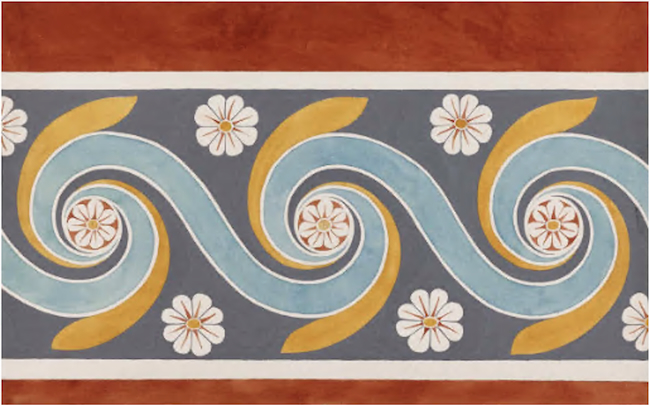
The British School at Athens celebrated its 50th anniversary in 1936 with a large public exhibition at Burlington House at the Royal Academy of Arts in London. The exhibition, British Archaeological Discoveries in Greece and Crete 1886-1936, consisted of a special display of Minoan culture related to the discoveries at Knossos by Sir Arthur Evans as well as the excavations of the School including: Phylakopi, Kamares Cave, Palaikastro, Mycenae, Sparta, Perachora, Thessaly, Macedonia, Lesbos, Cyprus, Ithaca, and Megalopolis (Arcadia). It also included displays of Travels and Studies in Greece and Asia Minor, the Genose in the Levant, Monasteries in Athos, Byzantine Music, Byzantine Architecture and Decorative Arts, Greek Island Embroideries, Special Studies of Greek Pottery and Sculpture, Restoration of Ancient Monuments, Studies of Modern Greek Life and the School buildings and officers.
Since original ancient artifacts could not be transported to the exhibition in London, the displays consisted of replicas of ancient artifacts, modern ethnographic artifacts and illustrative panels with original watercolour drawings, many of which were done by Émile Gilliéron and Piet de Jong, and photographs.
The 1936 Exhibition Collection contains the surviving panels with original artwork from this exhibition.

The items in this section of the exhibition were numbered 200-260, with no items 226-230. Items 231-260 were physical objects no longer in the possession of the BSA. 217 and 219 are missing.
An ink plan, drawn on paper and pasted onto canvas. Title in top left "Perachora Sketch Survey of Site." There is a scale bar along the lower left, and the artist's name (Piet de Jong) is written in the lower right corner. The original description in the catalogue reads: "General Plan of the Site and Excavations."
The original description in the catalogue reads: "206, 208. Terracotta Slabs, with which the upper part of the third temple of Hera Akraia was faced: water-colour drawings."
The original description in the catalogue reads: "The Entablature of the Third Temple of Hera Akraia (c. 525 B.C.): cf. 210."
The original description in the catalogue reads: "The Entablature of the Third Temple of Hera Akraia (c. 525 B.C.): cf. 210."
The original description in the catalogue reads: "206, 208. Terracotta Slabs, with which the upper part of the third temple of Hera Akraia was faced: water-colour drawings."
The original description in the catalogue reads: "206, 208. Terracotta Slabs, with which the upper part of the third temple of Hera Akraia was faced: water-colour drawings."
The original description in the catalogue reads: "206, 208. Terracotta Slabs, with which the upper part of the third temple of Hera Akraia was faced: water-colour drawings."
The original description in the catalogue reads: "206, 208. Terracotta Slabs, with which the upper part of the third temple of Hera Akraia was faced: water-colour drawings."
Five rows of black and white illustrations. Title in top in pencil "Elevation of sixth century temple of Hera Akraia", with "sixth century" crossed out. The illustrations have labels in ink: "plan of raking cornice"; "plan of tympanum blocks"; "plan of main cornice" "elevation of frieze and pediment" and "section through frieze" (both on same section); and "soffit plan of main cornice". There is a scale bar of metres at the bottom, and the illustrator's name in the lower right corner. Some further annotations in ink and pencil. The original description in the catalogue reads: "The Third Temple of Hera Akraia: elevation: a working drawing, not yet revised in all details."
An illustration of the top of an ionic column. Title at the top reads "Half full size details of ionic cap from Heraion Peraxora." The original description in the catalogue reads: "Ionic Column from the Portico: early 4th century."
The items in this section of the exhibition were numbered 301-399. 331, 339-344, 356, 363, 365-369, 383, 385-389 are missing (339-343 can be seen BSA SPHS 01/6841.C6850, 383-389 can be seen BSA SPHS 01/6830.C6839). There are no numbers 357-359, 370, 393.
A map drawn in ink over a black and white photograph. The title in the top right corner reads "Sketch Map of Limena shewing natural features, the ancient remains, modern occupation and character of cultivation 1907." There is a key and scale bar in the upper left corner, and a compass in the lower left corner. Towards the lower right is written in ink "J. Penoyre"; the same is written faintly in pencil to the lower left of this. The number 371 is pasted in the lower right corner, with the bottom half protruding from the lower edge of the map; it is also written and circled in pencil to the upper left of the compass. There is a reinforced hole in each corner. The original description in the catalogue reads: "Relief map of the ancient city of Thasos, photographed from a model. Note the tiny ancient harbour (Limena) and the ancient walls rising to include the citadel with summit tower and temple platform.”
Fragment of card base with one black and white photograph attached. Base in constructed of two pieces of card, joined horizontally at roughly the centre of the photograph. The number 384 is pasted in the centre below the image. To the right of this is written in pencil "u/p." The original description in the catalogue reads: "General view towards the Director's House from below: taken about 1905 before the olive-yard was turned into a garden."
The original description in the catalogue reads: "General view towards the Director's House from below: taken about 1905 before the olive-yard was turned into a garden."
One leather photo album with "The British School at Athens 1886-1936" on the front. The original description in the catalogue reads: "Portrait-book of officers and directors of the school, 1886-1936."
One photo album with "Excavations at the Cave of Trapeza Crete, B.S.A. 1936" on the front. On the inside front cover is a typewritten introduction to the album. The original description in the catalogue reads: "Book of photographs illustrating the Trapeza cave in Crete, supplementing the exhibit Nos. 316-7 in the North-east Angle-panel of this Room."
One envelope containing six black and white photographs that formed a single exhibit in the exhibition; the original display was at some point deconstructed. The original description in the catalogue reads: "Samarina... a. General View of the Village of Samarina; b. Market Place of Samarina, with its shops and inns; c. Principal Church of the Village, Great St Mary's Samarina: eighteenth century: a miraculous pine-tree grows on the roof of its apse; d. Monastery of St. Paraskevi, Samarina, which dates from before 1713 and lies in a sheltered spot lower down the valley, a short distance from the village; e. A saw mill; f. One of the old houses."
The original description in the catalogue reads: "Samarina... General View of the Village of Samarina."
The original description in the catalogue reads: "Samarina… Market Place of Samarina, with its shops and inns."
The original description in the catalogue reads: "Samarina… Principal Church of the Village, Great St Mary's Samarina: eighteenth century: a miraculous pine-tree grows on the roof of its apse."
The original description in the catalogue reads: "Samarina… Monastery of St. Paraskevi, Samarina, which dates from before 1713 and lies in a sheltered spot lower down the valley, a short distance from the village."
The original description in the catalogue reads: "Samarina… A saw mill."
The original description in the catalogue reads: "Samarina… One of the old houses."
This room contained Drawings of Byzantine Churches, numbered 401-569, and Byzantine Decorative Arts, numbered 501-628. The items from the drawing section 'Palestine', and all those from the 'Byzantine Decorative Arts', were lent by individuals and are, with the exception of one item which was later donated, not in the possession of the BSA
BRF 01/01/01/055. Colour illustration entitled "Kapnikarea Church Athens East Elevation" in the upper left corner. There is a Byzantine Research Fund copyright stamp in the lower right corner, with the original archive number written in. The original description in the catalogue reads: "The Kapnikarea Church... Megaw dates it to the third quarter of the 11th century, the exo-narthex (extreme west section) being an almost contemporary addition; the north aisle and south porch are later. East Elevation."
BRF 01/01/01/053. Colour illustration entitled "Kapnikarea Church Athens South Elevation" in the upper left corner. There is a Byzantine Research Fund copyright stamp in the lower right corner, with the original archive number written in. The original description in the catalogue reads: "The Kapnikarea Church... Megaw dates it to the third quarter of the 11th century, the exo-narthex (extreme west section) being an almost contemporary addition; the north aisle and south porch are later. South Elevation."
BRF 01/01/01/054. Colour illustration entitled "Kapnikarea Church Athens West Elevation" in the upper left corner. There is a Byzantine Research Fund copyright stamp in the lower right corner, with the original archive number written in. Below this is written in pencil RWS 1888. The original description in the catalogue reads: "The Kapnikarea Church... Megaw dates it to the third quarter of the 11th century, the exo-narthex (extreme west section) being an almost contemporary addition; the north aisle and south porch are later. West Elevation."
BRF 01/01/01/048. Colour illustration entitled "Kapnikarea Church Athens The Plan" in the upper left corner. There is a Byzantine Research Fund copyright stamp towards the upper right corner, with the original archive number written in. There is a scale bar at the bottom, and further annotations of parts of the building. The original description in the catalogue reads: "The Kapnikarea Church... Megaw dates it to the third quarter of the 11th century, the exo-narthex (extreme west section) being an almost contemporary addition; the north aisle and south porch are later. Ground Plan."
BRF 01/01/01/049. Colour illustration entitled "Kapnikarea Church Athens Longitudinal Section" in the upper left corner. There is a Byzantine Research Fund copyright stamp in the lower right corner, with the original archive number written in. The original description in the catalogue reads: "The Kapnikarea Church... Megaw dates it to the third quarter of the 11th century, the exo-narthex (extreme west section) being an almost contemporary addition; the north aisle and south porch are later. Longitudinal section."
BRF 02/01/01/005. One mounted black and white photograph of the exterior of a church, located in the centre of some modern buildings. The reverse reads "Athens Kaonuikarea (from S. West)." The original description in the catalogue reads: "The Kapnikarea Church... Megaw dates it to the third quarter of the 11th century, the exo-narthex (extreme west section) being an almost contemporary addition; the north aisle and south porch are later. Photograph of the Exterior."
BRF 01/01/01/111. Colour illustration entitled "Church of St Theodore South Elevation" in the upper left corner. There is a Byzantine Research Fund copyright stamp towards the lower right corner, with the original archive number written in. There is a scale bar at the bottom. The original description in the catalogue reads: "The Church of SS. Theodore... It is dated by an inscription to 1065, long mistakenly read as 1049. The relevance of the inscription to the existing church has been doubted; but, as Megaw has shown, without reason. It is therefore about contemporary with Kapnikarea, and with the two stand between St. Nicodemos and Daphni. East elevation."
BRF/01/01/01/110. Colour illustration entitled "Church of St Theodore South Elevation" in the upper left corner. There is a Byzantine Research Fund copyright stamp towards the lower right corner, with the original archive number written in. Some further annotations are visible. The original description in the catalogue reads: "The Church of SS. Theodore... It is dated by an inscription to 1065, long mistakenly read as 1049. The relevance of the inscription to the existing church has been doubted; but, as Megaw has shown, without reason. It is therefore about contemporary with Kapnikarea, and with the two stand between St. Nicodemos and Daphni. South elevation."
BRF 01/01/01/105. Colour illustration entitled "Church of St Theodore Athens Longitudinal Section" in the upper left corner. There is a Byzantine Research Fund copyright stamp towards the lower right corner, with the original archive number written in. The original description in the catalogue reads: "The Church of SS. Theodore... It is dated by an inscription to 1065, long mistakenly read as 1049. The relevance of the inscription to the existing church has been doubted; but, as Megaw has shown, without reason. It is therefore about contemporary with Kapnikarea, and with the two stand between St. Nicodemos and Daphni. Longitudinal section."
BRF 01/01/01/104. Colour illustration entitled "Church of St Theodore Athens Ground Plan" at the top. There is a Byzantine Research Fund copyright stamp towards the lower right corner, with the original archive number written in. There is a scale bar at the bottom, and further annotations of parts of the building. The original description in the catalogue reads: "The Church of SS. Theodore... It is dated by an inscription to 1065, long mistakenly read as 1049. The relevance of the inscription to the existing church has been doubted; but, as Megaw has shown, without reason. It is therefore about contemporary with Kapnikarea, and with the two stand between St. Nicodemos and Daphni. Ground plan."
BRF 01/01/01/058. Colour illustration entitled "Church of St Nicodemus Athens The Ground Plan" in the upper left corner. There is a Byzantine Research Fund copyright stamp in the lower right corner, with the original archive number written in. Scale bar at bottom. The original description in the catalogue reads: "The Church of St. Nicodemos… An inscription dates the founder's death to 1044, and Megaw puts the church in the second quarter of the 11th century. In 1847 it was take over by the Russian Orthodox, and elaborately restored. Ground plan."
BRF 01/01/01/059. Colour illustration entitled "Church of St Nicodemus Athens The Gallery Plan" in the upper left corner. There is a Byzantine Research Fund copyright stamp in the lower right corner, with the original archive number written in. Scale bar at bottom. The original description in the catalogue reads: "The Church of St. Nicodemos… An inscription dates the founder's death to 1044, and Megaw puts the church in the second quarter of the 11th century. In 1847 it was take over by the Russian Orthodox, and elaborately restored. Gallery plan."
BRF 01/01/01/073. Colour illustration entitled "Church of St Nicodemus Athens The South Elevation" in the upper left corner. There is a Byzantine Research Fund copyright stamp in the lower right corner, with the original archive number written in. Scale bar at bottom. The original description in the catalogue reads: "The Church of St. Nicodemos… An inscription dates the founder's death to 1044, and Megaw puts the church in the second quarter of the 11th century. In 1847 it was take over by the Russian Orthodox, and elaborately restored. South elevation."
BRF 01/01/01/069. Colour illustration entitled "Church of St Nicodemus Athens The West Elevation" in the upper left corner. There is a Byzantine Research Fund copyright stamp in the lower right corner, with the original archive number written in. Scale bar at bottom. The original description in the catalogue reads: "The Church of St. Nicodemos… An inscription dates the founder's death to 1044, and Megaw puts the church in the second quarter of the 11th century. In 1847 it was take over by the Russian Orthodox, and elaborately restored. West elevation."
BRF 01/01/01/006. Two ink illustrations on a single sheet of paper, with some additions in pencil. The upper illustration is titled "section looking east", and the lower "a plan of the church". To the lower right of each image is a Byzantine Research Fund copyright stamp; the lower of these has the original archive number written in. Two scale bars at bottom, one in feet and one in metres. The original description in the catalogue reads: "The Church of the Holy Apostles. - The trefoil plan of this church is derived from an early oriental type, e.g. the Church of the Nativity at Bethlehem. It is found fairly frequently at this time in Greece, particularly in the north; this example shows the form grafted on to the Greek Cross type. Constructionally it is related to the Churches of Holy Luke and St. Nicodemos, and is dated by Megaw to the first quarter of the 11th century. Section and plan."
BRF 01/01/01/019. Colour illustration showing the elevation of a church. The top is finished only in pencil. There are some pencil annotations, including "Church of the apostles. athens" in the upper left corner. To the lower right is a Byzantine Research Fund copyright stamp; the lower of these has the original archive number written in. The original description in the catalogue reads: "The Church of the Holy Apostles. - The trefoil plan of this church is derived from an early oriental type, e.g. the Church of the Nativity at Bethlehem. It is found fairly frequently at this time in Greece, particularly in the north; this example shows the form grafted on to the Greek Cross type. Constructionally it is related to the Churches of Holy Luke and St. Nicodemos, and is dated by Megaw to the first quarter of the 11th century. Elevation."
BRF 01/01/01/030. Two colour illustrations side by side entitled "The Cathedral Athens" in the upper centre, and "Cross Section" and "Longitudinal Section" below. There is a Byzantine Research Fund copyright stamp towards the upper right corner, with the original archive number written in. The original description in the catalogue reads: "The Old Metropolis (Cathedral): Panaghia Gorgoepekoös, also called St Eleutherios. It probably dates from the 9th century. The walls contain a mass of fragments of classical and early Byzantine sculpture. The church is small for a cathedral, but Byzantine Athens was not a large place. Section and plan."
BRF 01/01/01/029. Colour illustration entitled "The Cathedral Athens Plan" in the upper left corner. There is a Byzantine Research Fund copyright stamp towards the upper right corner, with the original archive number written in. There is a scale bar at the bottom, and further annotations of parts of the building. The original description in the catalogue reads: "The Old Metropolis (Cathedral): Panaghia Gorgoepekoös, also called St Eleutherios. It probably dates from the 9th century. The walls contain a mass of fragments of classical and early Byzantine sculpture. The church is small for a cathedral, but Byzantine Athens was not a large place. Section and plan."
BRF 01/01/01/038. Colour illustration of the elevation of church titled "The Cathedral Athens The East Elevation 1/2 inch scale." There is a Byzantine Research Fund copyright stamp below the title on the right. There is a further drawing of a cross in pencil above the title on the right. The original description in the catalogue reads: "The Old Metropolis (Cathedral): Panaghia Gorgoepekoos, also called St Eleutherios. It probably dates from the 9th century. The walls contain a mass of fragments of classical and early Byzantine sculpture. The church is small for a cathedral, but Byzantine Athens was not a large place. East and weast elevations."
BRF 01/01/01/036. Colour illustration of the elevation of church titled "The Cathedral Athens The West Elevation Half inch scale." There is a Byzantine Research Fund copyright stamp below the title on the right, with the original archive number written in. The original description in the catalogue reads: "The Old Metropolis (Cathedral): Panaghia Gorgoepekoos, also called St Eleutherios. It probably dates from the 9th century. The walls contain a mass of fragments of classical and early Byzantine sculpture. The church is small for a cathedral, but Byzantine Athens was not a large place. East and west elevations."
BRF 01/01/01/033. Ink illustration showing the elevation of a church. There is an upside-down Byzantine Research Fund copyright stamp in the lower right corner, with the original archive number written in. The original description in the catalogue reads: "The Old Metropolis (Cathedral): Panaghia Gorgoepekoos, also called St Eleutherios. It probably dates from the 9th century. The walls contain a mass of fragments of classical and early Byzantine sculpture. The church is small for a cathedral, but Byzantine Athens was not a large place. Elevations."
BRF 01/01/01/035. Ink illustration showing the elevation of a church. There is a Byzantine Research Fund copyright stamp in the lower right corner, with the original archive number written in. The original description in the catalogue reads: "The Old Metropolis (Cathedral): Panaghia Gorgoepekoos, also called St Eleutherios. It probably dates from the 9th century. The walls contain a mass of fragments of classical and early Byzantine sculpture. The church is small for a cathedral, but Byzantine Athens was not a large place. Elevations."
BRF 02/01/01/101. One mounted black and white photograph of the exterior of a church. The reverse reads "Athens Kaisariani 1 exterior from East". The original description in the catalogue reads: "This church belongs to the monastery at the foot of Mt. Hymettos to the east of Athens. It is dated by Megaw to the last quarter of the 11th century, and so is approximately contemporary with Daphni. Photographs: exterior; (96) exterior."
BRF 02/01/01/100. One mounted black and white photograph of the exterior of a church. The reverse reads "Exterior from West Athens Kaisariani 2". The original description in the catalogue reads: "This church belongs to the monastery at the foot of Mt. Hymettos to the east of Athens. It is dated by Megaw to the last quarter of the 11th century, and so is approximately contemporary with Daphni. Photographs: exterior; (96) exterior."
This section contains the items originally numbered 423-464, with no numbers 431, 444, 55, or 460-463