

About the 1936 Exhibition Collection
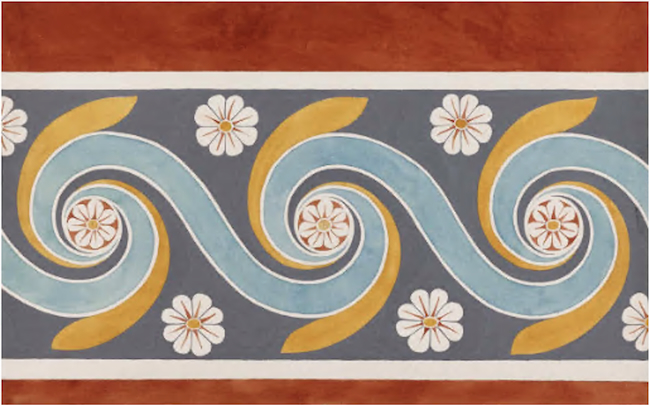
The British School at Athens celebrated its 50th anniversary in 1936 with a large public exhibition at Burlington House at the Royal Academy of Arts in London. The exhibition, British Archaeological Discoveries in Greece and Crete 1886-1936, consisted of a special display of Minoan culture related to the discoveries at Knossos by Sir Arthur Evans as well as the excavations of the School including: Phylakopi, Kamares Cave, Palaikastro, Mycenae, Sparta, Perachora, Thessaly, Macedonia, Lesbos, Cyprus, Ithaca, and Megalopolis (Arcadia). It also included displays of Travels and Studies in Greece and Asia Minor, the Genose in the Levant, Monasteries in Athos, Byzantine Music, Byzantine Architecture and Decorative Arts, Greek Island Embroideries, Special Studies of Greek Pottery and Sculpture, Restoration of Ancient Monuments, Studies of Modern Greek Life and the School buildings and officers.
Since original ancient artifacts could not be transported to the exhibition in London, the displays consisted of replicas of ancient artifacts, modern ethnographic artifacts and illustrative panels with original watercolour drawings, many of which were done by Émile Gilliéron and Piet de Jong, and photographs.
The 1936 Exhibition Collection contains the surviving panels with original artwork from this exhibition.

A print of an illustration of a rectangle with scrolls at either end. The object is decorated by 3x16 squares with a repeated step pattern. The original description in the catalogue reads: "Ivory inlay from a wooden casket, from Tomb 518, L.H. II (1500-1400 B.C.)."
Five watercolour drawings of sherds which was the content of panel 105; the original base is no longer extant. The original description in the catalogue reads: "Early and Middle Helladic from grave circle and palace: the fragments at the top, 2800-2000 B.C., except (e) which is Middle Helladic, are Early Helladic. The patterned pieces were found by Stamatakes in 1877, rediscovered by the British School in the cellar of the Nauplia Museum, and identified by the Greek letters written on them in pencil. The piece of a bowl with a flight of birds is Middle Helladic, shortly before 1600 B.C. Three pieces below are Middle Helladic, but somewhat earlier."
A print of an illustration of a mirror comprised of a textured circle with a decorated handle at the bottom. The image has been cut from a larger image; in some places the edges of the image are visible. The original description in the catalogue reads: "Bronze mirrors with (b) carved ivory handles, from the woman's grave in the entrance passage of the "Tomb of Clytemnestra," L.H. III (1400-1100 B.C.)."
A print of an illustration of a detail from 1936/01/04/01, showing the part of the handle where it attaches to the mirror itself. The original description in the catalogue reads: "Bronze mirrors with (b) carved ivory handles, from the woman's grave in the entrance passage of the "Tomb of Clytemnestra," L.H. III (1400-1100 B.C.)."
An illustration of a plaque showing two lions standing on their hind legs with there forelegs on a higher object. It is mostly a line drawing showing reconstruction, the only more detailed parts are the tail and right leg of the left-hand lion and the tail of the right-hand lion. The original description in the catalogue reads: "Fragments of ivory plaque (restored drawing), showing guardian lions in heraldic posture, from "Tomb of Aegisthus," L.H. II (1500-1400 B.C.)."
This series contains items associated with the exhibition but not displayed as part of the exhibition
The catalogue of exhibition. viii, 114 pages.
An illustration of a fragment of pottery with a black and white fish/bird on it. The original description in the catalogue reads: "Naturalistic designs, mostly floral, on Middle Cycladic pottery...: black, enhanced with red, on buff."
The exhibits in this room were divided into two main sections: Phylakopi and Excavations, Travels, and Studies of Sites and Monuments
The collection contains panels made out of board or paper, some of which were wall-mounted, as part of the BSA 50th anniversary exhibtion in 1936 at Burlington House, London. The panels are made up of black-and-white photographs, original ink and watercolour illustrations, and some prints. There were also two photo albums specially made for the exhibition.
BRF 01/01/07/246. Ink and pencil illustration of the elevation of a church. Title in upper left reads "Church of S. Panteleemon: Thessalonica" ; below "Panteleemon" is written "(the All Merciful)" in pencil. Smaller title in lower centre reads "South west elevation." "No 6" is written in ink in the upper left corner. There are two scale bars, one for feet on the lower left and one for metres on the lower right. To the upper right of the right-hand scale bar is a Byzantine Research Fund copyright stamp with the original archive number written in. There are some pencil annotations visible on the right edge. The original description in the catalogue reads: "The Church of St. Panteleëmon. - 561-2. Elevations: … 562, south-west."
A photograph of a jar with a vine pattern on it. It is largely in one piece, though parts of the rim are missing. In the photograph is a label with the number "40". The original description in the catalogue reads: "Naturalistic designs, mostly floral, on Middle Cycladic pottery...: black, enhanced with red, on buff."
An illustration of a vase with brown flowers on it. It has been stuck to base of much thicker card, which has then been attached to the base of this exhibit. The original description in the catalogue reads: "Naturalistic designs, mostly floral, on Middle Cycladic pottery...: black, enhanced with red, on buff."
An illustration of a vase with a pattern of swirls in several colours on it. Several sections are a paler colour, which may indicate these were not parts of the original fragments found but added to complete the vase before painting or imagined by the artist. The original description in the catalogue reads: "Conventional designs on vases of Late Minoan I and II styles a-d are native imitations in local clay."
An illustration of a vase with patterns made of thick red lines. The original description in the catalogue reads: "Conventional designs on vases of Late Minoan I and II styles a-d are native imitations in local clay."
An illustration of a vase with a pattern in several colours on it. Several sections are a paler colour, which may indicate these were not parts of the original fragments found but added to complete the vase before painting or imagined by the artist. The original description in the catalogue reads: "Conventional designs on vases of Late Minoan I and II styles a-d are native imitations in local clay."
An illustration of a fragment of pottery, showing the head of a bird. Different colours are suggested by the textures of the ink. The original description in the catalogue reads: "Conventional designs on vases of Late Minoan I and II styles ... e, f belong to the naturalistic group (6) above. These derivations of the naturalistic designs (6, above) supersede the local Cycladic style about 1500 B.C., and are characteristic of the early part of the Third Settlement of Phylakopi."
An illustration of a vase with two handles and a spout, with a pattern in several colours on it. Several sections are a paler colour, which may indicate these were not parts of the original fragments found but added to complete the vase before painting or imagined by the artist. The original description in the catalogue reads: "Conventional designs on vases of Late Minoan I and II styles a-d are native imitations in local clay."
An illustration of a fragment of pottery showing a floral design. Different colours are suggested by the textures of the ink. The original description in the catalogue reads: "Conventional designs on vases of Late Minoan I and II styles ... e, f belong to the naturalistic group (6) above. These derivations of the naturalistic designs (6, above) supersede the local Cycladic style about 1500 B.C., and are characteristic of the early part of the Third Settlement of Phylakopi."
A photograph showing the top of a vase. There are several large cracks in the vase and some pieces missing. The pattern shows octopuses and seaweed. In the photograph is a label with the number "37", and three and a half centimetres of a ruler. The original description in the catalogue reads: "Conventional designs on vases of Late Minoan I and II styles ... g-i, genuine L.M. II vases imported from Crete or the Mycenaean Mainland of Greece."
A photograph of a jar with a floral pattern on it. There are several cracks in it and parts of the rim are missing. In the photograph is a label with the number "18", and three centimetres of a ruler. The original description in the catalogue reads: "Conventional designs on vases of Late Minoan I and II styles ... g-i, genuine L.M. II vases imported from Crete or the Mycenaean Mainland of Greece."
A photograph of a jar with a pattern of lines and dots on it. There are several cracks in it and one section, paler than the rest, is probably a reconstruction of a missing section. In the photograph is a label with the number "163", and six and a half centimetres of a ruler. The original description in the catalogue reads: "Conventional designs on vases of Late Minoan I and II styles ... g-i, genuine L.M. II vases imported from Crete or the Mycenaean Mainland of Greece."
A photograph of a vase showing a man with a large eye holding a fish in each hand. There is a further spotted pattern below him. The original description in the catalogue reads: "8a Fisherman, naively portrayed in black and red on buff; one of a procession: contrast the vigorous naturalism of his two fishes and great eye, with the childish rendering of head and limbs."
A photograph of bronze statuette, seen from the front. There is some erosion of the lower half of the statuette. The original description in the catalogue reads: "8b Bronze statuette, recalling the earlier marble figures in Early Cycladic graves, but influenced by Cretan bronzes, and perhaps imported."
A photograph of a clay vessel which has two horn-like protrusions sticking out of either side, as well as a raised section at the top. There is a pattern similar to upside-down scales.
A photograph of the inside and top rim of a stone object. The rim has seven swirls on either side, and a gap at the top and bottom. In the lower gap there is a label, upside down, which reads "4921"
A photograph of the side of a stone object. A swirled pattern is visible on the wide rim, with the edge dipping further down at either end.
A photograph showing an ancient wall from the foreground right to the background left, with a man standing with one hand on the wall in the background. The photograph is pasted to a thick card base, which in turn is pasted onto the base of this exhibit. The original description in the catalogue reads: "9a The fortress wall of The Third Settlement, reconstructed on the remains of the First Wall."
A photograph showing a mosaic with the remains of some walls and pillars around it. A woman is stood on the mosaic to the left of the image, while a man is sitting down sketching in the lower right corner. The photograph is pasted to a thick card base, which is turn is pasted onto the base of this exhibit. The original description in the catalogue reads: "9b [Roman mosaic in a house of the classical city of Melos.]"
A photograph showing a bay surrounded by rocky outcrops and a pebble beach. On the rocks on the left side some walls are visible. The photograph is pasted to a thick card base, which in turn is pasted onto the base of this exhibit. The original description in the catalogue reads: "View of the prehistoric settlement, after excavation, above the beach on the left."
A photograph showing a flock of sheep travelling down a hill road from background right to foreground left. Behind the road is a hill, in front is the remains of a wall. The photograph is pasted to a thick card base, which in turn is pasted onto the base of this exhibit. The original description in the catalogue reads: "Flocks returning at evening (a) to the modern village, as they returned in Early Cycladic times. Clay oxen and pigs, and bones of domestic animals, fish, triton-shells and limpets were found in the early houses."
A photograph showing a body of water surrounded on the three visible sides by tall rocks, with a hole in one leading through to the rest of the water. The photograph is pasted to a thick card base, which in turn is pasted onto the base of this exhibit. The original description in the catalogue reads: "b. The bathing cove below the prehistoric site; part of the primitive harbour."
Card base with three illustrations attached. The number 12 is pasted in the lower and upper left corners, and the images are labelled with the pasted letters b, c, and a. To the right of image b (1936/01/01/08/01), and below the other two images, are later annotations in biro giving bibliographic references. The original description in the catalogue reads: "Ivory signet ring (a), illustrating religious ritual: a woman in a flounced skirt worships at a horned altar, among palm-like foliage: subject and style are alike reminiscent of Minoan Crete. Wall-paintings: (b) a seated man in Minoan dress and bracelets raises a drapery with one hand; his nails are stained red. c Design of lilies, reconstructed by Theodore Fyfe."
A watercolour illustration of fresco fragments showing what appears to be a seated or kneeling person holding a piece of textile. The original description in the catalogue reads: "(b) a seated man in Minoan dress and bracelets raises a drapery with one hand; his nails are stained red."
A black-and white watercolour illustration of four lilies in a repeating motif, with plain bands beneath. The original description in the catalogue reads: "c Design of lilies, reconstructed by Theodore Fyfe."
An ink illustration of the front and side view of a ring, the front shows a woman with a large skirt in front of an altar with some fern-like plants behind her. Underneath the side view is written "2/1". The original description in the catalogue reads: "Ivory signet ring (a), illustrating religious ritual: a woman in a flounced skirt worships at a horned altar, among palm-like foliage: subject and style are alike reminiscent of Minoan Crete."
An illustration of a pot with one handle, painted black with a design in white and red. Some parts are a paler colour, which may indicate these were not parts of the original fragments found but added to complete the vase before painting or imagined by the artist. The original description in the catalogue reads: "Middle Minoan pottery, simple ornament, black on buff."
An illustration of a pot, painted black with a design in white and red. Some parts are a paler colour, which may indicate these were not parts of the original fragments found but added to complete the vase before painting or imagined by the artist. The original description in the catalogue reads: "Middle Minoan pottery, simple ornament, black on buff."
An illustration of a pot with a spout, painted black with a design in white and red. Some parts are a paler colour, which may indicate these were not parts of the original fragments found but added to complete the vase before painting or imagined by the artist. The original description in the catalogue reads: "Middle Minoan pottery, simple ornament, black on buff."
An illustration of a pot with tow handles, painted black with a floral design in white and red. Some parts are a paler colour, which may indicate these were not parts of the original fragments found but added to complete the vase before painting or imagined by the artist. The original description in the catalogue reads: "Middle Minoan pottery, simple ornament, black on buff."
An illustration of a pot with two handles and a spout, painted black with a design in white and red. Some parts are a paler colour, which may indicate these were not parts of the original fragments found but added to complete the vase before painting or imagined by the artist. The original description in the catalogue reads: "Middle Minoan pottery, simple ornament, black on buff."
An illustration of a pot, painted black with a design in white and red. Some parts are a paler colour, which may indicate these were not parts of the original fragments found but added to complete the vase before painting or imagined by the artist. The original description in the catalogue reads: "Middle Minoan pottery, simple ornament, black on buff."
An illustration of a grey pot with a spout and handle, and a white design on the body. The original description in the catalogue reads: "Middle Minoan polychrome ware."
An illustration of an orange-brown pot with a handle, with a white design painted on. Some parts are a paler colour, which may indicate these were not parts of the original fragments found but added to complete the vase before painting or imagined by the artist. The original description in the catalogue reads: "Middle Minoan polychrome ware."
An illustration of the remains of a vase painted with red, orange, black, and white. Much of the pot is left blank: presumably the painted sections are those that survived, and the rest was recreated from the fragments. The original description in the catalogue reads: "Middle Minoan polychrome ware."
An illustration of an pot, painted grey with red and white decoration. One handle and a spout are visible. Some parts are a paler colour, which may indicate these were not parts of the original fragments found but added to complete the vase before painting or imagined by the artist. The original description in the catalogue reads: "Middle Minoan polychrome ware."
An illustration of pot with two handles and a spout, painted grey with red and white decoration. The original description in the catalogue reads: "Middle Minoan polychrome ware."
An illustration of pot with two handles and a spout, painted orange with red and white decoration. Some parts are a paler colour, which may indicate these were not parts of the original fragments found but added to complete the vase before painting or imagined by the artist. The original description in the catalogue reads: "Middle Minoan polychrome ware."
An illustration of pot with two handles and a spout, painted grey with a decoration of a white octopus with red and orange details. Some parts are a paler colour, which may indicate these were not parts of the original fragments found but added to complete the vase before painting or imagined by the artist. The original description in the catalogue reads: "Middle Minoan polychrome ware."
A photograph of a landscape. In the foreground are trees, beyond which a plain also with trees can be seen, leading up to mountains partly obscured by cloud. The top half of the image is the sky. In the bottom left corner is written "Boi//annay - Genève". The original description in the catalogue reads: "View from the cave, over the Messara Plain."