

About the 1936 Exhibition Collection
The British School at Athens celebrated its 50th anniversary in 1936 with a large public exhibition at Burlington House at the Royal Academy of Arts in London. The exhibition, British Archaeological Discoveries in Greece and Crete 1886-1936, consisted of a special display of Minoan culture related to the discoveries at Knossos by Sir Arthur Evans as well as the excavations of the School including: Phylakopi, Kamares Cave, Palaikastro, Mycenae, Sparta, Perachora, Thessaly, Macedonia, Lesbos, Cyprus, Ithaca, and Megalopolis (Arcadia). It also included displays of Travels and Studies in Greece and Asia Minor, the Genose in the Levant, Monasteries in Athos, Byzantine Music, Byzantine Architecture and Decorative Arts, Greek Island Embroideries, Special Studies of Greek Pottery and Sculpture, Restoration of Ancient Monuments, Studies of Modern Greek Life and the School buildings and officers.
Since original ancient artifacts could not be transported to the exhibition in London, the displays consisted of replicas of ancient artifacts, modern ethnographic artifacts and illustrative panels with original watercolour drawings, many of which were done by Émile Gilliéron and Piet de Jong, and photographs.
The 1936 Exhibition Collection contains the surviving panels with original artwork from this exhibition.

A watercolour illustration of a spindle whirl in red on buff from two angles; the upper shows the pattern on the underneath, and the lower shows the whorl in profile. Beneath the lower image is written in pencil 'h'. The original description in the catalogue reads: "Late Helladic I and II. From the Palace, "Tomb of Aegisthus," and Kalkani Cemetery (515); Late Helladic II (1500-1400 B.C.), except (b, f, i) which are Late Helladic I."
A watercolour illustration of a sherd in black on buff. In the lower right corner is written in pencil 'i'. The original description in the catalogue reads: "Late Helladic I and II. From the Palace, "Tomb of Aegisthus," and Kalkani Cemetery (515); Late Helladic II (1500-1400 B.C.), except (b, f, i) which are Late Helladic I."
A watercolour illustration of a sherd with a pattern of scales in black on buff. The original description in the catalogue reads: "Late Helladic I and II. From the Palace, "Tomb of Aegisthus," and Kalkani Cemetery (515); Late Helladic II (1500-1400 B.C.), except (b, f, i) which are Late Helladic I."
An ink illustration of an amphora with an intricate pattern. The original description in the catalogue reads: "Late Helladic I and II. From the Palace, "Tomb of Aegisthus," and Kalkani Cemetery (515); Late Helladic II (1500-1400 B.C.), except (b, f, i) which are Late Helladic I."
A watercolour illustration of a sherd in black on buff. Below the image is written in pencil 'm'. The original description in the catalogue reads: "Late Helladic I and II. From the Palace, "Tomb of Aegisthus," and Kalkani Cemetery (515); Late Helladic II (1500-1400 B.C.), except (b, f, i) which are Late Helladic I."
A watercolour illustration of a wide vase with two visible handles, in white with pattern in shades of brown. The original description in the catalogue reads: "Late Helladic I and II. From Kalkani Cemetery (515, 518, 529, 532); L.H. II (1500-1400 B.C.)."
A watercolour illustration of an egg-shaped vase in shades of brown. The original description in the catalogue reads: "Late Helladic I and II. From Kalkani Cemetery (515, 518, 529, 532); L.H. II (1500-1400 B.C.)."
A watercolour illustration of a pot with a spout and handle, decorated with black octopuses on white. The original description in the catalogue reads: "Late Helladic I and II. From Kalkani Cemetery (515, 518, 529, 532); L.H. II (1500-1400 B.C.)."
A watercolour illustration of a tall vase with two visible handles, decorates in brown on white with a pattern of scales. The original description in the catalogue reads: "Late Helladic I and II. From Kalkani Cemetery (515, 518, 529, 532); L.H. II *1500-1400 B.C.)."
A watercolour illustration of a jug, decorated with flowers in red on buff. The original description in the catalogue reads: "Late Helladic I and II. From Kalkani Cemetery (515, 518, 529, 532); L.H. II (1500-1400 B.C.)."
A watercolour illustration of a wide vase with two visible handles, decorated with a flower in red on buff. Beneath is shown the underside of the vase, which is cracked with some pieces missing. The original description in the catalogue reads: "Late Helladic I and II. From Kalkani Cemetery (515, 518, 529, 532); L.H. II (1500-1400 B.C.)."
A watercolour illustration of a cup with one handle, in red on buff. The original description in the catalogue reads: "Late Helladic I and II. From Kalkani Cemetery (515, 518, 529, 532); L.H. II (1500-1400 B.C.)."
A watercolour illustration of a wide vase with two visible handles, decorated in red on buff. Beneath is shown the underside of the vase. The original description in the catalogue reads: "Late Helladic I and II. From Kalkani Cemetery (515, 518, 529, 532); L.H. II (1500-1400 B.C.)."
A watercolour illustration giving the details of the rim, handle, and upper part of a vase, showing a decoration of flowers in black on white. The number 110 in pencil and some other erased writing is visible in the upper right corner. The original description in the catalogue reads: "Late Helladic I and II. From "Tomb of Aegisthus" and Kalkani Cemetery (518, 529): Late Helladic II (1500-1400 B.C.). "
A watercolour illustration of a wide vase with three visible handles, decorated in black on white. Beneath is shown the underside of the vase. The original description in the catalogue reads: "Late Helladic I and II. From "Tomb of Aegisthus" and Kalkani Cemetery (518, 529): Late Helladic II (1500-1400 B.C.). "
A watercolour illustration of a vase with two visible handles, decorated in black on white. The original description in the catalogue reads: "Late Helladic I and II. From "Tomb of Aegisthus" and Kalkani Cemetery (518, 529): Late Helladic II (1500-1400 B.C.). "
A watercolour illustration of a vase with three visible handles, decorated with a floral pattern in black on white. The original description in the catalogue reads: "Late Helladic I and II. From "Tomb of Aegisthus" and Kalkani Cemetery (518, 529): Late Helladic II (1500-1400 B.C.). "
A watercolour illustration of a wide vase with two visible handles, decorated in black on white. The original description in the catalogue reads: "Late Helladic I and II. From "Tomb of Aegisthus" and Kalkani Cemetery (518, 529): Late Helladic II (1500-1400 B.C.). "
A watercolour illustration of a wide vase with three visible handles, decorated with a floral pattern in black on white. The original description in the catalogue reads: "Late Helladic I and II. From "Tomb of Aegisthus" and Kalkani Cemetery (518, 529): Late Helladic II (1500-1400 B.C.). "
A watercolour illustration of a wide vase with three visible handles, decorated in black on white. The number 28 has been written and erased to lower right of image. The original description in the catalogue reads: "Late Helladic I and II. From "Tomb of Aegisthus" and Kalkani Cemetery (518, 529): Late Helladic II (1500-1400 B.C.). "
Seven illustrations showing eight pieces of pottery with parts of the original base card they were attached to. The images are labelled with pasted letters a-h, with the exception of f and g (1936/01/04/11/05, 06), where there marks which show their removal. Each fragment of base has the number 111 written in one of the corners. 1936/01/04/11/02-07 each have a number in a diamond written in the corner: the numbers in order are 2, 5, 3, 7,4, 1. On the base beside the two images in 1936/01/04/11/01 has been written in pencil and then erased the letters f and g. The original description in the catalogue reads: "Late Helladic III (1400-1100 B.C.). From Granary (by the Lion Gate), Third Kilometre (502), and Kalkani Cemeteries (520, 521). All except (e) and (h) belong to the last stage of this period, the twelfth century B.C."
Two watercolour illustrations of jugs with vertical spouts and one large handle extending over the centre, decorated in black on white. The original description in the catalogue reads: "Late Helladic III (1400-1100 B.C.). From Granary (by the Lion Gate), Third Kilometre (502), and Kalkani Cemeteries (520, 521). All except (e) and (h) belong to the last stage of this period, the twelfth century B.C."
A watercolour illustration of a jug with a vertical spout and two handles which join in the middle, decorated in red on buff, with a row of aquatic birds around the centre. Lines show where the fragments were reassembled, with paler-coloured sections indicating which sections were not found but have been reimagined.. The original description in the catalogue reads: "Late Helladic III (1400-1100 B.C.). From Granary (by the Lion Gate), Third Kilometre (502), and Kalkani Cemeteries (520, 521). All except (e) and (h) belong to the last stage of this period, the twelfth century B.C."
A watercolour illustration of a jug with a vertical spout and two handles which join in the middle, decorated in black on white. Lines show where the fragments were reassembled. The original description in the catalogue reads: "Late Helladic III (1400-1100 B.C.). From Granary (by the Lion Gate), Third Kilometre (502), and Kalkani Cemeteries (520, 521). All except (e) and (h) belong to the last stage of this period, the twelfth century B.C."
A watercolour illustration off a teacup shaped pot decorated in red on buff. Lines show where the fragments were reassembled. The original description in the catalogue reads: "Late Helladic III (1400-1100 B.C.). From Granary (by the Lion Gate), Third Kilometre (502), and Kalkani Cemeteries (520, 521). All except (e) and (h) belong to the last stage of this period, the twelfth century B.C."
A watercolour illustration of a pot with two handles, decorated in reds and browns on buff, with a flower and leaves. Lines show where the fragments were reassembled, with paler-coloured sections indicating which sections were not found but have been reimagined. The letter a has been painted to the lower right of the illustration. The original description in the catalogue reads: "Late Helladic III (1400-1100 B.C.). From Granary (by the Lion Gate), Third Kilometre (502), and Kalkani Cemeteries (520, 521). All except (e) and (h) belong to the last stage of this period, the twelfth century B.C."
A watercolour illustration of a pot with two handles, decorated with aquatic birds in red on buff. Lines show where the fragments were reassembled. The letter b has been painted to the lower right of the illustration. The original description in the catalogue reads: "Late Helladic III (1400-1100 B.C.). From Granary (by the Lion Gate), Third Kilometre (502), and Kalkani Cemeteries (520, 521). All except (e) and (h) belong to the last stage of this period, the twelfth century B.C."
A watercolour illustration of a vase with a handle painted brown on white, with the decoration presented flat beneath it. The decoration shows wheels and a variety of animals, including a cow and an aquatic bird, and a human woman. Some erased writing is visible in the corners. The original description in the catalogue reads: "Late Helladic III (1400-1100 B.C.). From Granary (by the Lion Gate), Third Kilometre (502), and Kalkani Cemeteries (520, 521). All except (e) and (h) belong to the last stage of this period, the twelfth century B.C."
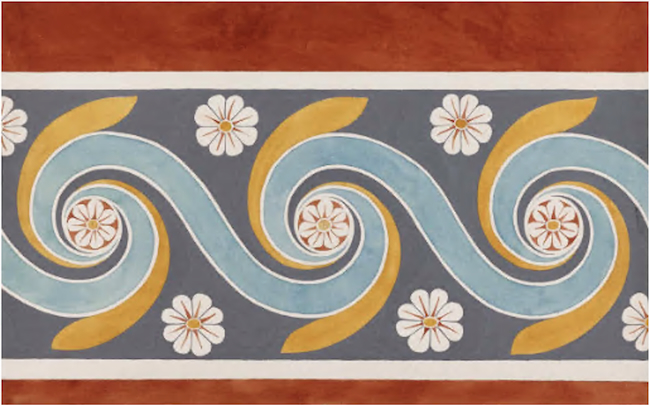
A watercolour illustration of a proposed reconstruction of a fresco in red, blue, yellow, black, and white depicting a repeating design with spiral and flowers. The surviving sections on which the reconstruction is based are slightly raised and with more detailed and darker paint, rather than flat colours. The original description in the catalogue reads: "Spiral and lotus design, found by Tsountas near the Western portal, possibly L.H. II (1500-1400 B.C.): reconstructed drawing."
Two watercolour images of frescoes which once formed a single exhibition panel: the card base of this panel is no longer extant. The original description in the catalogue reads: "Painted stucco from the hearth in the palace Megaron: and other fragments: all L.H. III (1400-1100 B.C.). a. Patterns of the third layer of stucco on the repainted Hearth. b. Rosette flower, from near the Grand Staircase."
A watercolour illustration of four rows of fresco in blue, red, white, and purple. The rows are labelled on the right edge 3A-3D from the bottom to the top. Rows 3A and 3C have a wave and rosette pattern, 3B a blue stripe, and 3D a pattern of spirals. Some writing is visible around the label 3C.The original description in the catalogue reads: "Painted stucco from the hearth in the palace Megaron: and other fragments: all L.H. III (1400-1100 B.C.). a. Patterns of the third layer of stucco on the repainted Hearth."
A watercolour illustration of a flower in blue, red, and white. The surviving sections on which the reconstruction is based are slightly raised and with more detailed and darker paint, rather than flat colours. '114' is written sideways in the top right corner. The original description in the catalogue reads: "Painted stucco from the hearth in the palace Megaron: and other fragments: all L.H. III (1400-1100 B.C.). b. Rosette flower, from near the Grand Staircase."
A watercolour illustration of two rows of a wave and rosette pattern, the top row in red and the lower in black, with blue bands above and below them. Some writing is faintly visible near the top and in the upper and lower right corners. The original description in the catalogue reads: "Painted stucco from the hearth in the palace Megaron: and other fragments: all L.H. III (1400-1100 B.C.). a. Wave patterns: hearth, first, second, fifth, sixth layers."
A watercolour illustration of a row of smooth red waves, and below two rows of red and blue waves coming outwards from a centre paler blue line. The original description in the catalogue reads: "Painted stucco from the hearth in the palace Megaron: and other fragments: all L.H. III (1400-1100 B.C.). a. Wave patterns: hearth, first, second, fifth, sixth layers."
A watercolour illustration of a red wave pattern and below it part of a blue wave pattern with a red rosette. The rows of waves are both above lines of paler blue. Some writing is faintly visible in the lower right corner. The original description in the catalogue reads: "Painted stucco from the hearth in the palace Megaron: and other fragments: all L.H. III (1400-1100 B.C.). a. Wave patterns: hearth, first, second, fifth, sixth layers."
A watercolour illustration of a pattern of spirals with stripes in the background in red, blue, yellow, black, and white. The original description in the catalogue reads: "Painted stucco from the hearth in the palace Megaron: and other fragments: all L.H. III (1400-1100 B.C.). b. Step of painted stucco found near the Western Portal."
A watercolour illustration of a proposed reconstruction of a fresco of a chariot in red, blue, and yellow, with black and white details. The surviving sections on which the reconstruction is based are slightly raised and with more detailed and darker paint, rather than flat colours. The original description in the catalogue reads: "Painted stucco from the hearth in the palace Megaron: and other fragments: all L.H. III (1400-1100 B.C.). Chariot, reconstructed from fragments of stucco, probably found in the Megaron."
The original description in the catalogue reads: "Beads of carnelian, amethyst faïence and glass (1600-1400 B.C.), from Tombs 518 and 529: L.H. I and II."
The original description in the catalogue reads: "Wing of ivory inlaid with blue paste, and beads of lapis lazuli, carnelian, faïence and glass; from the woman's grave in the entrance passage of the "Tomb of Clytemnestra" (1400-1300 BC). Gold rosette, bronze arrowhead, and beads of bronze, carnelian onyx, amethyst and glass; Tomb 515: L.H. II (1500-1400 B.C.)."
The original description in the catalogue reads: "Wing of ivory inlaid with blue paste, and beads of lapis lazuli, carnelian, faïence and glass; from the woman's grave in the entrance passage of the "Tomb of Clytemnestra" (1400-1300 BC). Gold rosette, bronze arrowhead, and beads of bronze, carnelian onyx, amethyst and glass; Tomb 515: L.H. II (1500-1400 B.C.)."
The original description in the catalogue reads: "Scarabs of reign of Amenhotep III (c.1411-1380 B.C.); beads of amber, faïence, glass, carnelian, onyx, crystal, agate and steatite; from Tomb 526, beginning of L.H. III, 14th century B.C."
The original description in the catalogue reads: "Gold pendants from necklaces (left and right), from Tombs 55, 68 and 515 at Mycenae, and from chamber tomb at Argos (1500-1400 B.C.). Embossed gold plaques and beads (centre) from same grave as (c)."
The original description in the catalogue reads: "Gold pendants from necklaces (left and right), from Tombs 55, 68 and 515 at Mycenae, and from chamber tomb at Argos (1500-1400 B.C.). Embossed gold plaques and beads (centre) from same grave as (c)."
The original description in the catalogue reads: "Gold pendants from necklaces (left and right), from Tombs 55, 68 and 515 at Mycenae, and from chamber tomb at Argos (1500-1400 B.C.). Embossed gold plaques and beads (centre) from same grave as (c)."
An ink illustration of a reconstruction of the Mycenae Palace. Description at the bottom reads "Mycenae Palace Sketch reconstruction of north west angle of court". Original pencil lines are visible in places. The original description in the catalogue reads: "Restored-drawing of the north-western angle of the Court of the Palace. L.H. III (1400-1100 B.C.). "
A black and white photograph showing the top of the lion gate in the foreground, with part of the grave circle visible behind. The top third of the image shows the landscape of the other hills and the sky The original description in the catalogue reads: "Lion gate: photograph of the limestone relief of the guardian lions and sacred pillar above the Gate. This was worked with bronze chisels, untoothed saws and reed drills, and dates from the beginning of L.H. III, 14th century B.C.; within appear the Grave Circle of the Royal Shaft Graces and the houses to the south; and on the ridge beyond the Cyclopean wall, the entrance to the 'Treasury of Atreus.'"
An ink plan titled 'Treasury of Atreus', showing it from three different angles as well as a floor plan. A key in the top right shows which materials are used for which section. A scale bar is at the bottom. It is signed P. de Jong. In the lower right is written in pencil "reduce to 1/2 linear". Some original pencil lines are visible. The original description in the catalogue reads: "'"Treasury of Atreus": plan showing the details of this famous beehive tomb."
The items in this section of the exhibition were numbered 141- 199, with no number 162. Exhibits 184-199 were physical objects which are no longer in the possession of the BSA. Items 150 and 151 are missing, though we can identify them from the background of BSA SPHS 01/6831.C6840 as the photographs BSA SPHS 01/5041.7840 and BSA SPHS 01/7602.C2774. Number 168 is missing and unidentified.
Canvas base with map attached. The number 142 is pasted in the lower left corner. There are holes in each corner, with a further three along the long edges and one in the centre of each short edge: some of these are reinforced. The original description in the catalogue reads: "General Map of Sparta and Neighbourhood, showing extant remains and excavated sites."
A watercolour map showing modern Sparta (in red), some excavated sites, and the ancient city walls (a dotted line). Most land is shown as green, with elevation in shades of brown. Notably buildings are painted black. The original description in the catalogue reads: "General Map of Sparta and Neighbourhood, showing extant remains and excavated sites."